


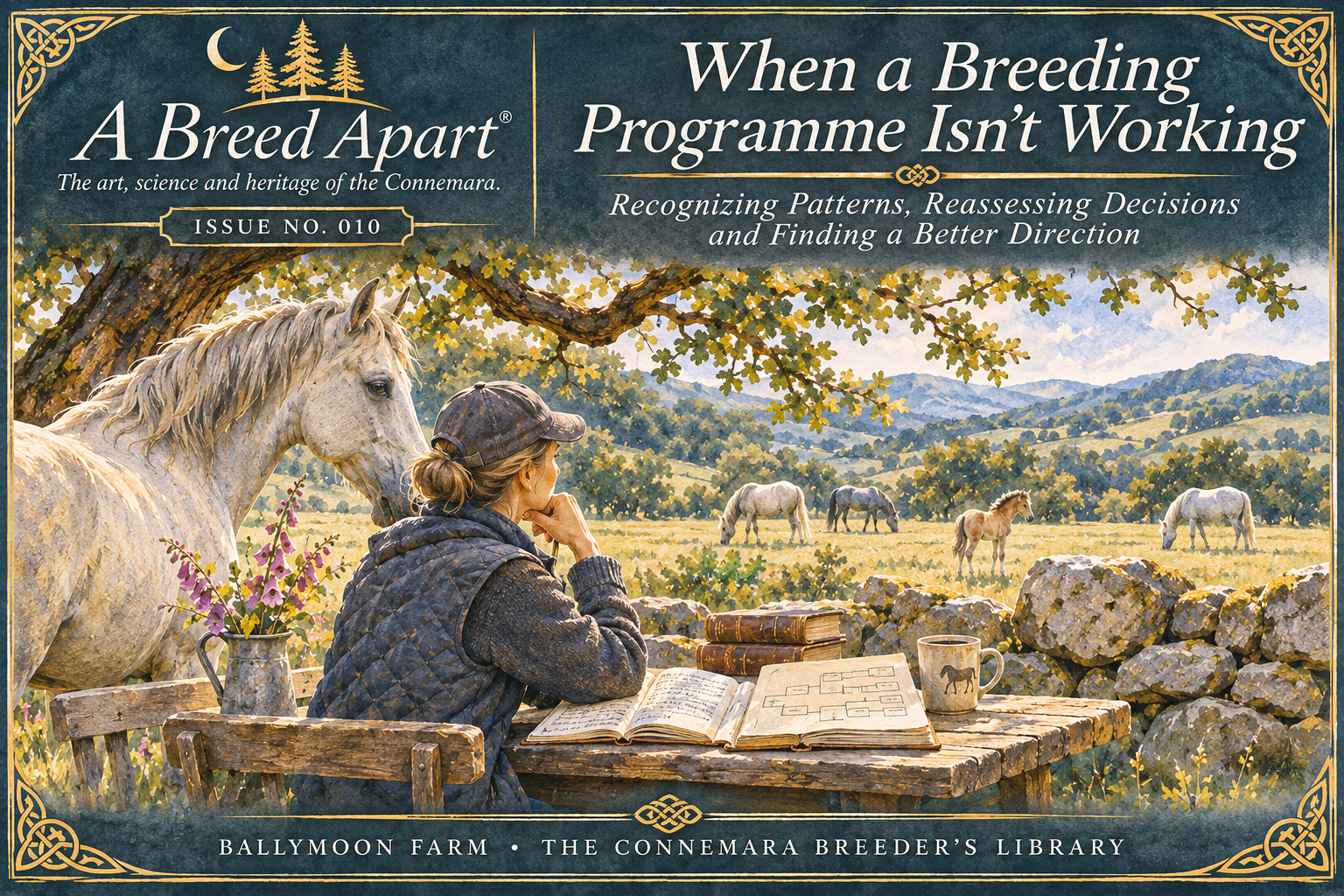
A Breed Apart · Issue No. 010 — The Art and Science of Breeding the Connemara
When a Breeding Programme Isn’t Working
Recognizing Patterns, Reassessing Decisions and Finding a Better Direction

One disappointing foal may be an unfortunate outcome. A recurring pattern of disappointing offspring deserves investigation. The ability to recognize the difference is one of the most important skills a breeder can develop.
Introduction — The courage to question our own breeding decisions
There is a considerable difference between being an experienced horse breeder and having a successful breeding programme.
Experience tells us how long someone has been breeding horses. It does not necessarily tell us whether their breeding decisions have resulted in improvement.
Breeding programmes can gradually lose direction. Weaknesses may become familiar enough that they are no longer recognized. A favorite bloodline may receive more consideration than its actual production record. Commercial success may obscure declining functional quality.
Sometimes a breeder becomes so invested in a particular direction that changing course feels like abandoning years of work.
Yet the willingness to question our own decisions is fundamental to responsible breeding.
In our previous articles, we explored complementary breeding, heritability, stallion production, maternal families and the selection of future breeding stock.
This article brings those principles together by addressing a more uncomfortable question:
What happens when the horses we are producing are not becoming the horses we intended to breed?
Part I — Defining What Isn’t Working
1. You cannot recognize failure without defining success
Before determining whether a breeding programme is working, we must establish what it was intended to accomplish.
A programme dedicated to producing traditional, versatile Connemara ponies may have different priorities from one producing partbred event horses.
A breeder emphasizing amateur suitability may make different selections from a breeder producing horses for professional competition.
Neither programme can be evaluated fairly without understanding its objectives.
For a purebred Connemara programme, objectives might include:
- Recognizable breed type.
- Excellent temperament and trainability.
- Functional conformation and soundness.
- Appropriate bone and substance.
- Natural athletic ability.
- Genetic diversity.
- Long-term usefulness.
- Preservation of the breed’s characteristic versatility.
The clearer these objectives are, the easier it becomes to recognize when production is moving away from them.
2. Producing foals is not the same as making progress
A breeding programme may produce healthy foals every year, sell them successfully and receive considerable attention on social media.
These achievements do not necessarily demonstrate genetic improvement.
The important question is whether successive generations are becoming more consistent in the characteristics the breeder values.
If the same structural weaknesses continue to appear, if temperament becomes less predictable or if recognizable breed type gradually disappears, the programme may be multiplying horses without meaningfully improving them.
This distinction will become particularly important in our next article, The Difference Between Multiplying and Improving.
3. Commercial success can conceal breeding problems
The marketplace does not always reward the same characteristics that contribute to long-term breed improvement.
Fashionable colors, popular pedigrees, extravagant movement and impressive photographs can all contribute to commercial appeal.
A foal may sell quickly despite possessing characteristics that would make it a questionable breeding prospect.
Conversely, an exceptionally useful and correctly constructed pony may attract less immediate attention.
Commercial viability matters. Breeders must be able to support their horses and sustain their programmes.
However, sales figures should not become the sole measure of breeding success.
4. A disappointing foal does not necessarily indicate a disappointing mating
Even carefully selected parents can produce an offspring that does not meet expectations.
Genetic recombination creates variation. Environmental influences affect development. Chance plays a role in every mating.
One offspring provides limited evidence about the genetic contribution of either parent.
The breeder must distinguish between an isolated outcome and a recurring pattern.
A single disappointing foal should prompt documentation and investigation, not necessarily the immediate rejection of an otherwise valuable mare or stallion.
5. Consistency is often more valuable than occasional brilliance
Imagine two hypothetical breeding programmes.
| Outcome | Programme A | Programme B |
|---|---|---|
| Ten offspring evaluated | 10 | 10 |
| Exceptional individuals | 2 (20%) | 1 (10%) |
| Meets objective | 3 | 8 |
| Below objective | 5 | 1 |
Hypothetical educational example. All offspring are assumed to have been evaluated using comparable criteria.
Programme A has produced more exceptional individuals, but Programme B has produced a substantially greater proportion of horses meeting its breeding objective.
Which programme is more successful?
The answer depends partly upon the objective, but for a breeder seeking dependable, versatile ponies, Programme B may offer a more sustainable foundation.
The occasional outstanding horse should not distract us from the quality of the wider population.
Part II — Recognizing the Warning Signs
6. The same conformational weaknesses keep appearing
Recurring structural weaknesses are among the clearest reasons to reassess a breeding programme.
These might include long backs, weak loins, insufficient bone, undesirable hock construction, poor feet, restricted elbow clearance or disproportionate body construction.
The important word is recurring.
When similar characteristics appear across several offspring, particularly across different matings, the breeder should investigate the common ancestry and management circumstances.
Continuing to produce the same weakness while hoping the next foal will be different is not a reliable improvement strategy.
7. The ponies are becoming less recognizable as Connemaras
Breed type can be lost gradually.
One generation becomes slightly more refined. Another possesses less substance. Another develops proportions more characteristic of a modern sport horse.
Each individual change may seem relatively minor.
Over several generations, however, the cumulative effect can become substantial.
Conceptual illustration of cumulative breed-type erosion, not measured genetic data.
A breeder may be improving a particular sporting characteristic while simultaneously losing important characteristics of the breed.
Sporting ability and recognizable Connemara type should not be regarded as mutually exclusive objectives.
8. Temperament is becoming increasingly unpredictable
A programme that consistently produces difficult, excessively reactive or unsuitable horses deserves careful evaluation.
Temperament is influenced by genetics, early experience, management, health and training.
It would therefore be inappropriate to assume that every behavioral problem is inherited.
However, when similar behavioral characteristics appear among related horses raised in different environments, the possibility of a familial contribution deserves investigation.
For the Connemara, temperament is not simply a commercial preference.
It is an important component of the breed’s versatility and usefulness.
9. Soundness problems are appearing repeatedly
Soundness problems can have numerous causes.
Nutrition, footing, exercise, hoof care, injury, developmental conditions and inherited predispositions may all contribute.
A breeder should pay particular attention when related offspring experience similar problems, especially at relatively young ages or under ordinary workloads.
The appropriate response is investigation with veterinary professionals, not an immediate assumption that the problem is genetic.
Nevertheless, repeatedly dismissing such problems as bad luck can prevent the recognition of a meaningful family pattern.
10. The horses look promising but do not develop into useful riding horses
A young horse may perform beautifully in hand or at liberty.
Its eventual usefulness under saddle may tell a different story.
The breeder should follow the development of offspring beyond foal inspections and young-horse evaluations.
Are they comfortable to ride? Are they trainable? Do they remain sound? Are they suitable for their intended riders? Do they enjoy their work?
The answers to these questions may be more informative than early show-ring success alone.
11. You are increasingly dependent on one exceptional offspring
An outstanding offspring can be a tremendous source of pride.
However, repeatedly using that horse as evidence of the quality of an entire breeding programme may conceal considerable variation among its relatives.
A stallion with one exceptional competitor and numerous unsuitable offspring deserves a different evaluation from a stallion consistently producing useful, sound and trainable horses.
The same principle applies to broodmares.
Evaluate the distribution of outcomes, not simply the highest achievement.
12. Every generation requires the same corrections
Complementary breeding should help preserve strengths while addressing weaknesses.
If every generation requires a stallion to improve bone, correct hocks, improve temperament or strengthen the topline, the breeder should question whether selection is accomplishing its intended purpose.
Some characteristics are difficult to improve and require several generations.
Nevertheless, repeatedly retaining individuals with the same significant weaknesses may prevent progress.
The next stallion should not continually be expected to repair problems that could have been reduced through more rigorous retention decisions.
13. The breeding herd is growing, but the quality is not
A larger broodmare herd does not necessarily represent a more successful programme.
If additional mares are retained without clear selection objectives, the breeder may gradually accumulate animals rather than improve the population.
This can reduce the resources available for developing and evaluating the most valuable prospects.
A smaller group of carefully selected mares may offer greater long-term potential than a large group of inconsistently evaluated breeding animals.
Part III — Identifying the Actual Cause
14. Is the problem genetic, environmental or both?
Most characteristics of practical importance in horses are influenced by multiple factors.
A youngster’s development reflects its genetic inheritance, prenatal environment, nutrition, health, management and experiences.
A breeder who attributes every problem to genetics may overlook opportunities to improve management.
A breeder who attributes every problem to management may continue propagating undesirable inherited characteristics.
Both errors can be costly.
A simplified quantitative-genetic model describes observable variation as:
P = G + E
Where P is phenotype, G represents genetic effects and E represents environmental effects.
Real biological systems may also involve interactions between genetics and environment, maternal effects and other sources of variation.
The equation is a conceptual starting point, not a method for diagnosing an individual horse.
15. Examine the mare before blaming the stallion
When a foal disappoints, attention frequently turns toward the stallion.
However, the mare contributes approximately half of the foal’s nuclear genetic material and also provides its prenatal environment.
Her individual characteristics, family history and previous production deserve careful consideration.
If a mare produces similar weaknesses when bred to several unrelated stallions, that pattern may provide useful evidence.
It does not establish genetic causation, but it identifies an area requiring investigation.
The mare must receive the same level of scrutiny as the stallion.
16. Examine the stallion beyond your own offspring
A breeder may have produced only one or two foals by a particular stallion.
Those offspring represent a very small portion of his potential production.
Investigating his offspring from other mares and breeding establishments may help establish whether a characteristic is recurring across different maternal backgrounds.
This is why evaluating a stallion as a producer is so important.
His own performance and conformation are valuable information, but his wider production record may provide additional insight into the characteristics he contributes.
17. Examine the specific combination
Sometimes neither parent appears to be consistently associated with a particular problem, but their combination produces undesirable results.
Two horses may possess different characteristics that interact unfavorably in their offspring.
They may also share underlying genetic predispositions that are not immediately apparent.
A mating can be disappointing without either parent being universally unsuitable for breeding.
The appropriate response may be to reconsider the combination rather than abandon both bloodlines.
18. Look for patterns among full and half-siblings
Different family relationships provide different kinds of information.
| Relationship | What it may help investigate |
|---|---|
| Full siblings | Variation within the same parental combination |
| Maternal half-siblings | Recurring characteristics associated with the mare or shared maternal environment |
| Paternal half-siblings | Recurring characteristics across different mares |
| Maternal relatives | Persistence of characteristics within a female family |
| Offspring raised elsewhere | Whether patterns persist under different management |
| Unrelated contemporaries | Possible shared environmental or management influences |
These comparisons do not independently prove inheritance.
They help the breeder formulate better questions and identify where further investigation may be useful.
19. Investigate the prenatal and early developmental environment
A breeding programme begins long before the foal is born.
Mare nutrition, body condition, health, placental function and pregnancy complications may influence fetal development.
After birth, growth rate, nutrition, exercise opportunities, illness and hoof management can affect the developing youngster.
If several foals raised under similar conditions exhibit developmental concerns, the breeder should review the management programme as well as their pedigrees.
Changing stallions will not resolve a nutritional or management problem.
20. Investigate training and placement
A horse’s apparent failure may reflect an unsuitable placement rather than unsuitable breeding.
An athletic, sensitive pony may struggle with an inexperienced rider but thrive with a skilled and sympathetic trainer.
A mature pony may develop behavioral difficulties because of discomfort, inconsistent handling or unsuitable equipment.
Conversely, exceptional training may compensate for characteristics that the breeder should still recognize as undesirable.
Performance outcomes should be interpreted within the context in which they were achieved.
Part IV — Learning to Recognize Patterns
21. Create a complete production record
Breeders often remember exceptional offspring particularly well.
Disappointing offspring, horses sold young and individuals that never entered competition may receive less attention.
This creates an incomplete picture.
A useful production record includes every known offspring, not simply the most successful.
Record parentage, birth year, developmental observations, temperament, health, conformation, inspection results, performance, owner feedback and the horse’s eventual role.
Missing information should remain identified as missing.
22. Understand the denominator
A stallion advertised as having produced ten successful competition horses may sound impressive.
But how many offspring has he produced?
Ten successful horses from fifteen evaluated offspring provide different evidence from ten successful horses among two hundred offspring.
Even then, the proportion of offspring given appropriate competition opportunities matters.
The breeder should distinguish between:
- Total offspring produced.
- Offspring old enough to evaluate.
- Offspring with meaningful follow-up.
- Offspring given relevant opportunities.
- Offspring meeting the defined breeding objective.
Without this context, success stories can be difficult to interpret.
23. Interactive production outcome calculator
How well is your programme working?
Evaluated offspring meeting objective: 75.0%
Follow-up coverage of eligible offspring: 80.0%
Depending on the unknown outcomes, the proportion of eligible offspring meeting your objective could range from 60.0% to 80.0%.
The purpose of this exercise is not to establish a universal acceptable success rate.
It is to help the breeder recognize how incomplete information can influence the interpretation of production results.
24. Avoid drawing conclusions from very small samples
A small breeder may produce only one or two foals annually.
This makes it difficult to distinguish genuine patterns from ordinary variation.
If two offspring exhibit a similar weakness, that may be worth investigating, but it is rarely sufficient to establish the precise cause.
Small sample sizes should encourage careful documentation, collaboration and continued investigation.
They should not encourage either unwarranted certainty or the dismissal of potentially important concerns.
25. Record what you do not know
An offspring that has not competed is not necessarily an unsuccessful athlete.
An offspring without a reported health problem is not necessarily confirmed sound.
A horse whose owner has not provided feedback should not automatically be classified as successful.
Unknown outcomes must remain unknown.
This principle protects the breeder from constructing a production record based primarily upon assumptions.
26. Recognize survivorship and reporting bias
Successful horses are more likely to appear in competition databases, advertisements and social media posts.
Horses that did not fulfill expectations may be less visible.
This creates a distorted picture when evaluating a bloodline through publicly available information alone.
Contacting owners and maintaining long-term relationships with purchasers can provide a more representative understanding of production.
Even then, the breeder should acknowledge the limitations of the available evidence.
27. Investigate trends across generations
One of the most informative ways to evaluate a breeding programme is to compare successive generations using consistent criteria.
Are the daughters generally better constructed than their mothers?
Are undesirable characteristics becoming less frequent?
Are the ponies remaining recognizable as Connemaras?
Is temperament becoming more dependable?
Are the horses demonstrating useful longevity?
These questions move the breeder away from individual success stories and toward an evaluation of the programme itself.
Interactive multigenerational trend explorer
Are your priorities being preserved?
Enter comparable average assessments from three generations. Use 0 for unknown.
Breed type: Declining
Bone and substance: Unchanged
Functional conformation: Improving
Temperament: Declining
Athletic ability: Improving
The hypothetical starting values demonstrate a particularly important possibility: athletic ability may improve while breed type and temperament decline.
Whether that represents success depends upon the breeding objective.
For a versatile purebred Connemara programme, such a trade-off deserves careful reconsideration.
Part V — The Psychology of Breeding Decisions
28. Becoming blind to the weaknesses in your own horses
Breeders spend considerable time looking at their own horses.
Over time, familiar characteristics may begin to appear normal.
A long back, insufficient bone or undesirable limb construction may become so common within the herd that the breeder no longer recognizes it as a weakness.
This is sometimes informally described as barn blindness.
Visiting other breeding establishments, attending inspections, studying mature horses and seeking knowledgeable independent opinions can help recalibrate the breeder’s eye.
29. The influence of emotional attachment
A favorite mare may possess significant breeding value.
She may also possess characteristics that should not be perpetuated.
These two realities can coexist.
Acknowledging a mare’s weaknesses does not diminish the pleasure she has brought her owner or the value of her accomplishments.
Responsible selection requires recognizing the whole animal.
30. The sunk-cost fallacy
A breeder may have invested many years and considerable financial resources into a particular bloodline.
Abandoning that direction may feel wasteful.
However, past investment does not establish the future suitability of a breeding animal.
Continuing an unsuccessful mating or retaining unsuitable descendants simply because of the resources already invested may compound the original problem.
The next breeding decision should be based upon future potential, not the desire to justify past expenditure.
31. Confirmation bias
Breeders naturally look for evidence supporting their decisions.
A successful offspring may receive considerable attention, while less desirable outcomes are explained away.
This tendency is known as confirmation bias.
A useful exercise is to ask:
What evidence would convince me that this mating was not successful?
If the breeder cannot identify any possible evidence that would change their opinion, the mating is no longer being evaluated objectively.
32. The influence of reputation and bloodline loyalty
Certain bloodlines may acquire almost legendary reputations.
Their historical contribution may be substantial and deserving of recognition.
However, no pedigree should exempt an individual horse from evaluation.
An unsuitable descendant does not become suitable simply because it carries the name of an influential ancestor.
Preserving a bloodline responsibly means selecting its valuable representatives, not perpetuating every individual within it.
33. Comparing your horses with the wrong population
A Connemara breeder may become increasingly influenced by the characteristics rewarded in warmblood sport-horse evaluations.
While there is much to learn from other breeding programmes, their objectives may differ.
A characteristic desirable in one population may not carry the same importance in another.
The Connemara’s native pony heritage, substance, temperament and versatility must remain part of the evaluation.
Improving athletic ability should not require abandoning the identity of the breed.
34. Breeding to prove someone wrong
Occasionally a breeding decision becomes influenced by disagreement with another breeder, inspector or judge.
The breeder may repeat a mating to demonstrate that an earlier criticism was unjustified.
However, breeding horses to defend an opinion is a poor substitute for evaluating evidence.
Independent criticism should be assessed on its merits.
It need not always be accepted, but neither should it automatically be rejected.
Part VI — Reassessing Your Breeding Stock
35. Conduct an honest broodmare audit
Every broodmare should periodically be evaluated against the current breeding objective.
Consider her individual quality, production history, temperament, soundness, reproductive welfare, genetic contribution and the availability of suitable stallions.
A mare that was appropriate for the programme ten years ago may no longer represent its best future direction.
This does not mean she was a poor mare.
It may mean the programme has progressed.
36. Conduct an equally rigorous stallion audit
Stallions should not receive less scrutiny because of their popularity, purchase price, performance record or emotional significance.
A mature stallion’s production record should gradually become an increasingly important part of his evaluation.
The breeder should investigate whether his offspring are meeting the intended objectives, whether undesirable characteristics recur and which types of mares appear to complement him.
The purpose is to understand his contribution, including its limitations.
37. Distinguish a valuable individual from a valuable producer
An exceptional riding horse may produce relatively ordinary offspring.
An unremarkable competition horse may become a particularly valuable producer.
Individual merit and breeding merit are related, but they are not identical.
This is one reason a programme based entirely upon competition achievements may produce disappointing results.
The horse’s relatives and offspring provide additional evidence that individual performance cannot supply.
38. Recognize the importance of reproductive welfare
A genetically valuable mare may no longer be an appropriate candidate for pregnancy.
Age, reproductive history, chronic illness, previous foaling complications and other veterinary concerns must be considered.
The desire to preserve a family does not justify placing a mare’s welfare at unacceptable risk.
The same principle applies to stallions whose health or management circumstances make continued breeding inappropriate.
Sometimes the responsible decision is to conclude an animal’s breeding career while recognizing the value of its previous contribution.
39. Determine whether the family should continue through another individual
Discontinuing the breeding career of one mare does not necessarily mean abandoning her maternal family.
A daughter, granddaughter or another suitable relative may provide a better opportunity to preserve the family’s desirable characteristics.
This is one of the advantages of developing a recognizable broodmare family.
The breeder is not dependent upon a single individual indefinitely.
40. Interactive breeding stock audit
Does this horse still serve your breeding objective?
This educational worksheet is not a veterinary examination, genetic evaluation or breeding approval.Part VII — Lessons from Ballymoon Farm
41. Improvement does not require rejecting the foundation mare
Glenormiston Amelia provides an excellent example of why breeders should distinguish between recognizing a weakness and dismissing an otherwise valuable animal.
Amelia possessed exceptional bone and substance, beautiful movement, natural jumping ability and a particularly kind temperament.
She was an excellent mother and earned premium recognition through both the American Connemara Pony Society and the Weser-Ems programme.
We also recognized that she could have possessed slightly greater depth through her hocks.
That observation did not negate her numerous strengths.
Instead, it helped establish a characteristic to consider when evaluating her descendants.
The objective was to preserve her contribution while continuing to improve the family.
42. Recognizing improvement through successive generations
Through Amelia’s daughter R Titania and granddaughter R Sparrows Zephyr, we have been able to observe the persistence of desirable bone and substance.
Zephyr possesses excellent limb conformation and beautiful joint quality, without the slight lack of hock depth we recognized in Amelia.
Glenormiston Amelia — Foundation mare
Excellent bone, substance and
temperament
Slightly light through the hocks
↓
R Titania — Daughter by Ard Celtic Art
Preservation of excellent
bone
Important continuation of the maternal family
↓
R Sparrows Zephyr — Granddaughter by Sparrows Zeus
Excellent bone,
joints and limb conformation
The original hock concern is not
observed
Based on firsthand breeder observations, not standardized measurements or proof of a particular inheritance mechanism.
This is an example of the distinction between a family possessing a weakness and a family failing to improve.
A breeding programme does not need to produce perfect horses.
It needs to recognize opportunities for improvement and make informed decisions about which characteristics should continue.
43. Learning from repeated matings
The five full siblings produced by R Blue Moon and Lady’s Comet provide another useful opportunity for evaluation.
Minnie Comet DF, R Comet Kaze, R Boogie Fever, R Serious Moonlight and R Blue Ruby share the same parents.
Following their development in different homes can help us understand the variation within that particular mating.
It also allows us to investigate whether desirable characteristics recur under different management and training circumstances.
The value of this family is not simply that five foals were produced.
It is the opportunity to learn from five genetically distinct individuals representing the same parental combination.
44. Learning from offspring beyond the original farm
The developing branches of Amelia’s family illustrate why a breeder’s evaluation should extend beyond the horses currently owned.
Through R Pandoras Art Work and her colt PS Sir Gorgeous Artwork, by Woodlander Sir Gorgeous, at Peachstone Farm — and reportedly through Wildwych Whiskey Bay and Devons Got Lotsa Bling — the maternal family has continued elsewhere.
These branches may eventually provide valuable information about the family’s wider contribution.
Their complete production histories are still being documented.
Maintaining relationships with other breeders and owners allows us to develop a more comprehensive understanding of the horses we produce.
45. Do not manufacture a success story
It is tempting to present every breeding decision as successful when writing about one’s own programme.
However, meaningful education requires acknowledging uncertainty.
The Ballymoon Farm examples in this article illustrate documented family relationships and breeder observations. They are not presented as proof that every mating has been successful or that every descendant meets our objectives.
A programme should remain open to reassessment even when it possesses valuable bloodlines and encouraging production evidence.
Part VIII — Deciding What Needs to Change
46. When to change the stallion
Changing stallions may be appropriate when a mating repeatedly produces characteristics inconsistent with the breeding objective.
It may also be appropriate when the mare’s strengths are not being adequately preserved or when genetic diversity and future compatibility become concerns.
The next stallion should be selected to address a clearly identified objective.
Simply choosing a different stallion without understanding why the previous mating disappointed may introduce new problems without resolving the original ones.
47. When to discontinue breeding a mare
A mare’s breeding career may need to conclude for reasons of health, welfare, production consistency or incompatibility with the programme’s direction.
This is a significant decision, particularly when the mare represents a valuable family.
However, continuing to breed an individual solely because of her pedigree may not serve the programme or the mare.
Retirement, an appropriate nonbreeding role or continuation of the family through a suitable descendant may be preferable.
48. When to discontinue a particular mating
A specific mating may be worth reconsidering when repeated offspring demonstrate undesirable combinations of characteristics.
The breeder should review the seriousness of the concerns, the number of offspring evaluated, management influences and the wider production records of both parents.
Sometimes a single serious welfare or health concern warrants suspending a mating while it is investigated.
The breeder does not need to produce additional affected offspring merely to establish a larger sample.
49. When to reconsider a maternal branch
An established family may develop several branches.
Some may consistently preserve the family’s desirable characteristics. Others may gradually lose them.
The breeder should evaluate each branch on its own merits.
Continuing one branch while discontinuing another can represent successful selection within the family rather than rejection of its original foundation.
50. When to introduce new blood
An established breeding programme may benefit from introducing a carefully selected mare or stallion from another family.
New genetic contributions may provide opportunities to improve particular characteristics, reduce excessive relatedness and increase future mating options.
However, introducing new blood should not become an automatic response to every disappointing outcome.
The incoming individual must possess qualities that complement the existing programme.
Novelty alone does not establish breeding value.
51. When to stop breeding temporarily
Sometimes the most responsible breeding decision is not to produce another foal.
A temporary pause may allow the breeder to evaluate existing youngsters, investigate health concerns, review management, improve facilities or reconsider the financial sustainability of the programme.
Breeding another generation before understanding the results of the previous one may make an existing problem more difficult to resolve.
A year without foals can be a productive year for a breeding programme.
52. When the breeding objective itself needs revision
Occasionally the problem is not the breeding stock but the objective.
The breeder may be attempting to achieve too many competing goals simultaneously.
For example, a programme may seek extreme refinement, substantial bone, exceptional height, traditional pony proportions, international sporting ability and suitability for inexperienced children.
Some of these objectives can coexist, but others may create practical or biological trade-offs.
Prioritizing the characteristics that matter most can make selection more coherent.
Part IX — A Practical Breeding Programme Diagnostic Tool
53. Identify the problem before choosing the solution
The following framework is designed to help breeders organize their observations.
It is not intended to establish genetic causation.
Where should you investigate first?
Establish the seriousness of the concern before making further breeding commitments. Improve offspring follow-up and document where the characteristic occurs.
A review of relevant management and environmental influences should form part of the investigation.
54. A recurring weakness does not automatically require abandoning a bloodline
Some weaknesses may be manageable through appropriate selection and complementary mating.
Others may be sufficiently serious that continuing the affected breeding branch is difficult to justify.
The breeder should consider the seriousness of the characteristic, its effect on welfare and function, the available evidence about inheritance and the possibility of selecting suitable alternatives.
There is an important distinction between improving an imperfect family and knowingly perpetuating a serious problem.
55. Change one meaningful variable when practical
When investigating disappointing production, changing numerous factors simultaneously can make it difficult to understand which changes contributed to subsequent outcomes.
Where appropriate, a breeder might retain the same general management approach while selecting a different stallion, or review nutrition before interpreting developmental outcomes.
However, welfare concerns must always be addressed promptly.
Management improvements should never be withheld merely to create a more controlled comparison.
Horse breeding is not a laboratory experiment, and the welfare of the animals takes precedence over the convenience of collecting data.
56. Establish a measurable improvement objective
A statement such as “I want to breed better ponies” is too broad to guide a meaningful reassessment.
A more useful objective might be:
Preserve recognizable Connemara type and excellent bone while reducing the frequency of undesirable hock construction among mature offspring.
Or:
Improve the consistency of amateur-suitable temperament without sacrificing functional athletic ability.
Specific objectives allow the breeder to assess whether subsequent decisions are moving the programme in the intended direction.
57. Establish a baseline
Before implementing changes, document the current state of the programme.
This may include the number of breeding animals, known offspring outcomes, recurring characteristics, health concerns, genetic diversity considerations and available resources.
Without a baseline, improvement can be difficult to recognize.
The breeder may remember the programme as better or worse than the records actually indicate.
58. Allow enough time for meaningful evaluation
Horses have relatively long generation intervals.
A breeding decision made today may not be fully evaluated for several years.
A foal’s mature conformation, ridden temperament, soundness and eventual production cannot all be established at birth.
This makes patience essential.
However, patience should not be confused with ignoring emerging evidence.
The breeder can reassess decisions throughout development while acknowledging the limitations of early observations.
Part X — Creating a Recovery Plan
59. The breeding programme recovery worksheet
A recovery plan should identify what is working as well as what needs to change.
The objective is not necessarily to rebuild the entire programme.
It may be to preserve valuable characteristics while correcting a specific weakness in selection or management.
Reassess, refine and move forward
Save your completed plan in your permanent breeding records.60. Seek independent evaluation
Independent assessment can provide a valuable perspective on familiar horses.
Breed inspectors, experienced breeders, veterinarians, farriers and appropriate trainers may each contribute different kinds of expertise.
No single individual necessarily possesses all the knowledge required to evaluate a breeding programme comprehensively.
The breeder should seek informed opinions, examine the reasoning behind them and integrate relevant observations into their decisions.
61. Improve relationships with offspring owners
Long-term communication with purchasers can be one of the most valuable investments a breeder makes.
Owners may provide information about temperament, trainability, soundness, mature conformation and everyday usefulness that never appears in competition records.
Feedback should be welcomed even when it is disappointing.
An owner reporting a problem is providing potentially valuable information about the breeding programme.
Encouraging open communication can help identify concerns earlier and improve future decisions.
62. Protect the valuable parts of the programme
When a breeding programme encounters difficulties, there may be a temptation to change everything.
However, the existing herd may possess characteristics that have taken generations to establish.
Excellent temperament, bone, recognizable type, longevity or a particularly valuable maternal family should not be discarded without careful consideration.
The goal is targeted improvement.
A recovery plan should identify which characteristics must be preserved just as clearly as it identifies those requiring change.
63. Recognize progress that does not attract publicity
Some of the most important improvements in a breeding programme may never result in a championship photograph.
A reduction in difficult temperaments, better limb construction, improved hoof quality, more consistent breed type or greater suitability for amateur riders may represent substantial progress.
These achievements deserve recognition even when they are less visible than competition results.
The ultimate measure of a breeding programme should reflect its purpose, not merely its public recognition.
64. Know when a smaller programme is a better programme
A breeder may discover that maintaining fewer broodmares allows more rigorous selection, better management and more complete evaluation of offspring.
Reducing the number of foals produced can create opportunities to improve the quality of the programme.
Growth in numbers should never be confused with growth in merit.
Sometimes the most significant improvement begins by breeding fewer horses.
Part XI — The Annual Breeding Programme Review
65. A breeder’s annual self-assessment
The following checklist is intended to be revisited before making the next season’s breeding decisions.
Annual programme review
0 / 16
66. The five-year perspective
Annual reviews help identify immediate concerns.
A longer review period can help identify changes that are less obvious from year to year.
Every few years, the breeder should compare the current herd with the animals that established the programme.
Would the breeder choose the current mares over their predecessors?
Are the horses more consistent in type, temperament and functionality?
Have important characteristics been lost?
Are there more or fewer suitable mating options?
Has the programme become financially and practically sustainable?
These questions help determine whether the breeding programme is developing a meaningful direction.
67. The responsibility to future breeders
Every breeding animal sold to another establishment may influence horses beyond the original programme.
This makes transparency particularly important.
Breeders should communicate known health concerns, relevant genetic information, significant structural observations and uncertainties about production.
The reputation of a breeding programme should be built upon the quality of its horses and the reliability of its information.
Concealing problems may protect an individual sale, but it can undermine the long-term interests of the breed.
Part XII — Test Your Understanding
Recognizing when a programme needs to change
0 of 8 answered · 0 correct
The Breeder’s Takeaway
A successful breeding programme is not one that never produces a disappointing horse.
Such a programme does not exist.
A successful programme recognizes its strengths, investigates its weaknesses and makes increasingly informed decisions about the future.
It understands that individual brilliance does not necessarily establish production consistency.
It recognizes that fashionable characteristics may not contribute to long-term breed improvement.
It appreciates that valuable foundation mares can possess imperfections without diminishing their contribution.
It follows offspring beyond the original farm and welcomes information that challenges earlier assumptions.
Most importantly, it remains willing to change.
At Ballymoon Farm, the continuing influence of Glenormiston Amelia reminds us that meaningful breeding decisions may extend across several generations.
The objective is not to reproduce Amelia exactly.
It is to recognize what made her valuable, preserve those characteristics and continue improving upon them.
That same principle applies to every worthwhile breeding programme.
We should be able to look at the horses we are producing today and explain how they contribute to the horses we hope to produce tomorrow.
When we can no longer answer that question convincingly, it is time to reassess our direction.
The measure of a breeder is not the ability to defend every decision they have made.
It is the ability to learn from those decisions and make better ones.
Glossary
| Term | Definition |
|---|---|
| Breeding objective | The defined characteristics a breeding programme intends to improve or preserve. |
| Genetic progress | Change in the genetic merit of a population over successive generations. |
| Phenotypic trend | Change in observable characteristics over time, potentially reflecting genetic and environmental influences. |
| Production consistency | The frequency with which offspring demonstrate characteristics aligned with a breeding objective. |
| Selection pressure | The influence of differential reproductive contribution on the characteristics of subsequent generations. |
| Breed-type erosion | Gradual loss of characteristics that contribute to recognizable breed identity. |
| Barn blindness | Informal term describing reduced objectivity toward familiar horses. |
| Confirmation bias | The tendency to favor information supporting existing beliefs. |
| Survivorship bias | Distortion resulting from greater visibility of successful or surviving individuals. |
| Reporting bias | Distortion caused by some outcomes being more likely to be reported than others. |
| Sunk-cost fallacy | Continuing an activity primarily because of resources already invested. |
| Maternal effect | Influence of the mother on offspring phenotype beyond the offspring’s own direct genetic effects. |
| Genotype-environment interaction | Differences in how genetic characteristics are expressed under different environmental conditions. |
| Generation interval | Average age of parents when producing offspring that become parents of the next generation. |
| Baseline | An initial documented assessment used for subsequent comparison. |
| Genetic diversity | Variation in genetic characteristics within a population. |
| Corrective selection | Selection intended to reduce undesirable characteristics while preserving desirable ones. |
| Production audit | Structured review of breeding animals and their recorded offspring outcomes. |
References and further reading
- Falconer, D. S., and Mackay, T. F. C. Introduction to Quantitative Genetics. Fourth edition, 1996.
- Lynch, M., and Walsh, B. Genetics and Analysis of Quantitative Traits. 1998.
- Walsh, B., and Lynch, M. Evolution and Selection of Quantitative Traits. 2018.
- Mrode, R. A. Linear Models for the Prediction of Animal Breeding Values. Third edition, 2014.
- FAO. Breeding Strategies for Sustainable Management of Animal Genetic Resources. 2010.
- FAO. In Vivo Conservation of Animal Genetic Resources. 2013.
- Nickerson, R. S. “Confirmation Bias: A Ubiquitous Phenomenon in Many Guises.” Review of General Psychology, 1998.
- Arkes, H. R., and Blumer, C. “The Psychology of Sunk Cost.” Organizational Behavior and Human Decision Processes, 1985.
- American Connemara Pony Society — breed standards and inspection resources.
- Connemara Pony Breeders’ Society — breed standards and studbook resources.
- American Association of Equine Practitioners — veterinary and equine welfare resources.
- Ballymoon Farm — firsthand observations and breeder-supplied production and maternal family records.
Editorial note: The scientific references provide background for the principles discussed. The interactive tools are original educational frameworks, not scientifically validated genetic evaluation systems. Hypothetical examples are identified as such. Ballymoon Farm family observations and production information have not been independently verified for this edition. The references have not undergone a fresh source-by-source verification for this draft.
Continue exploring in the Library
- Breeding With Intent — A Breed Apart, Issue No. 001.
- The Mare Is More Than Half the Equation — Issue No. 002.
- Complementary Breeding — Issue No. 003.
- What Is Actually Heritable? — Issue No. 004.
- Understanding Prepotency — Issue No. 005.
- The Full Sibling Paradox — Issue No. 006.
- Evaluating a Stallion as a Producer — Issue No. 007.
- Building a Recognizable Broodmare Family — Issue No. 008.
- Knowing Which Foals to Retain — Issue No. 009.
A Breed Apart — The Art and Science of Breeding the Connemara
Previous: Issue No. 009 — Knowing Which Foals to Retain
Next: Issue No. 011 — The Difference Between Multiplying and Improving
Previous Post
Next Post








For more of our latest photos and inspiration, follow along on instagram at @instapony_.
© Redbud Ranch 2020 | Connemara Sport Horses and Ponies | photos by Lisa Martin |
terms & Condtions |
privacy Policy
Intentionally Bred with People in Mind
Browns Valley, CA
+ Show / Hide Comments
Share to: