


By Lisa Martin, Ballymoon Farm
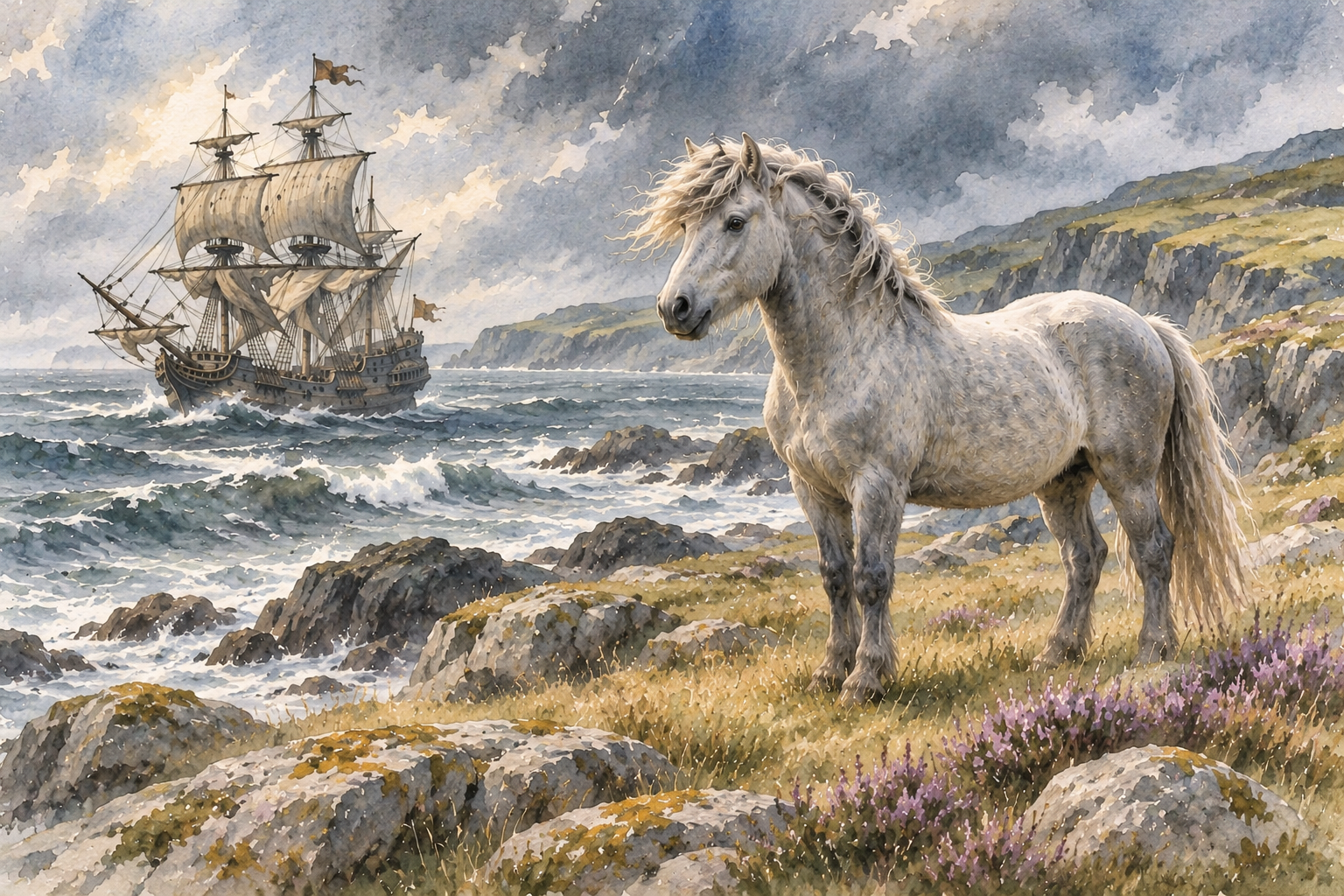
Every Connemara breeder knows the story. In 1588, the Spanish Armada wrecked along Ireland’s west coast, and Spanish stallions swam ashore to breed with the native ponies — giving us, so the tale goes, the Connemara’s elegance, its dark colours, its proud head carriage.
It is a wonderful story. But is it true? Until recently, we had no way to test it. Now we do — because DNA keeps records that paper never did. And what the DNA says is more interesting than the legend: there is Spanish blood in this breed, written into its sire lines. It just almost certainly didn’t arrive by shipwreck.
The fingerprint in the father line
A pony’s Y chromosome passes from father to son, essentially unchanged, down the tail-male line. Read it, and you are reading the history of a breed’s stallions.
In 2026, a study at the University of Veterinary Medicine Vienna (Jetzinger) tested 38 Connemara males from ten countries, covering all five of the breed’s active sire lines. (I sent one of the mane-hair samples myself.) The study found four Y-chromosome fingerprints in the modern breed. The most common — carried by 14 of the 38 stallions, including the whole Mountain Lad line and most of Cannon Ball — is known to researchers as daC_Ad-b, and the global research behind it describes it as Spanish-derived.
That description comes from a much larger study: in 2024, Radovic, Wallner and colleagues published a Y-chromosome survey of 1,517 stallions from 189 breeds in the Proceedings of the National Academy of Sciences. They named the Connemara as one of six British and Irish pony breeds — alongside the Dales, Dartmoor, Fell, Highland and Kerry Bog — in which this Spanish-derived sire line predominates. Within that family of haplotypes, the Spanish horses carry the older, branching forms, while the British and Irish ponies carry the later twigs: the family tree’s roots are in Spain.
So the Spanish connection is real, and it is not a trace. In the sire lines sampled, it is the single biggest thread.
But read the dates carefully
Here is where the legend and the evidence part company.
The 2024 study dates the spread of Spanish horse blood across Europe to roughly the 8th through 16th centuries — a span of some 800 years. It makes no mention of the Armada. And the Spanish-derived haplotype itself has an estimated common ancestor around 435 years ago — a figure that lands temptingly close to 1588, and that will no doubt be quoted as proof. It isn’t. That date is when the family line itself began, wherever in Europe its founder stood. It says nothing about when a descendant of that line first set hoof in Ireland, which could have been generations earlier or later.
The mare side tells a different story
If Spanish horses had washed ashore in numbers and bred freely with the native stock, we would expect to see Iberian traces in the mares as well. Mitochondrial DNA, which passes from mother to foal, lets us check.
We don’t see them. In the landmark 2002 mitochondrial survey (Jansen and colleagues, PNAS), Connemara mares fell into a cluster the authors described as distinctive for northern European ponies — the same cluster found in Viking-age horses — and separate from the cluster well represented in Iberian and North African breeds. Later Irish work (McGahern and colleagues, 2006) and a 2020 survey of British and Irish native breeds (Winton and colleagues) tell the same story: on the dam side, the Connemara is a northern pony.
That pattern — Spanish sires, native mares — is exactly the signature of deliberate importation: valuable stallions brought in, one at a time, to improve local stock. It is not the signature of a shipwreck.
What the history books add
The wrecks themselves are real: around 33 Armada ships were lost on the Irish coast in the autumn of 1588, some of them along the Galway and Connemara shore. But the details work against the legend. The Armada’s cavalry never embarked in Spain at all — the plan was to ferry an army across from Flanders, so the ships carried few horses. On the desperate return voyage, horses aboard were thrown overboard as drinking water ran short. And Spanish sailors who did reach shore in Clare and Galway were, on the Lord Deputy’s orders, executed. Few men survived those beaches; breeding herds of stallions did not swim ashore and vanish into the bogs.
Meanwhile, a quieter and better-documented channel ran for centuries. Galway was medieval Ireland’s great port for trade with Spain and France. Breed historians record Barb and Andalusian stallions imported into Ireland in the 16th century, and Spanish stallions were imported into England in large numbers from the 14th to the 17th centuries — from where their sons crossed to Ireland as a matter of ordinary commerce. As far back as 1900, the horse writer Walter Gilbey argued it was “quite needless to invoke” shipwrecks to explain the Spanish character in British and Irish ponies: imported sires explained it. The British Connemara Pony Society’s own breed history, drawn from Pat Lyne’s Shrouded in Mist, reaches the same conclusion today — it calls the Armada story “a popular myth” and trade the more likely source.
The Thoroughbred thread
If Spanish blood is the surprise in the sire lines, Thoroughbred blood is the open secret. Two of the Vienna study’s four fingerprints are Thoroughbred threads. One, found in most of the Little Heaven line, is a marker researchers trace back to Whalebone, the 1810 Derby winner — a name any racing fan knows. The other, carried by most of the Connemara Boy line, is an older thread that also runs through the Byerley Turk, one of the three foundation sires of the Thoroughbred itself.
None of this happened by accident either. In the years when the breed was being shaped, Thoroughbred and Arab stallions were deliberately put to Connemara mares to add size, quality and athleticism — and the traffic ran both ways: in one study of mare-line DNA, the Thoroughbred was the closest of all the breeds compared to the Connemara.
The partnership never really ended. The Connemara × Thoroughbred cross became one of the most successful sport-horse recipes in the world — the pony’s sense and soundness under a longer, more athletic frame — and it is the cross I breed myself: most of the mares who come to R Blue Moon are Thoroughbreds and sport mares, and my own Ruby is exactly that cross, by Blue out of a Thoroughbred mare. Spain may have given the breed some of its fire. The Thoroughbred helped give it wings.
What we still can’t say
Honesty requires a gap to be named. No published genome-wide study has yet measured how much Iberian ancestry the modern Connemara carries overall. The first genomic study of the breed (Lindsay-McGee and colleagues, 2023) compared Connemaras with Warmbloods and looked within the breed; it did not test the Spanish question. The Y chromosome speaks for one line of fathers; mitochondrial DNA for one line of mothers. Between those two threads lies most of the genome, still unexamined for this question. Ancient DNA may one day settle it — researchers published 87 ancient Iberian horse genomes in 2025 — but no Irish pony remains from the right place and period have yet been tested.
So: Spanish blood, yes. Armada, no.
Weigh it all, and the evidence supports this: Spanish stallions contributed to the Connemara, probably repeatedly, across centuries of trade between Ireland, England and Spain. The sire-line DNA is genuinely Spanish-derived; the mare lines stayed northern; the documents record imports, not castaways.
I find I don’t miss the legend. A shipwreck is an accident. What the evidence describes instead is horsemen, generation after generation, choosing good Spanish sires on purpose to improve the ponies of a hard coast — which is to say, stewardship. The breed wasn’t made by chance. It was made by decisions. That is a better story, and it has the advantage of being true.
References
- Jetzinger, S.A. (2026). Y-chromosomal lineages as a window into the breeding history of the current Connemara pony population. Diploma thesis, University of Veterinary Medicine Vienna.
- Radovic, L., Remer, V., Rigler, D., et al. (2024). The global spread of Oriental horses in the past 1,500 years through the lens of the Y chromosome. Proceedings of the National Academy of Sciences, 121(49), e2414408121.
- Jansen, T., Forster, P., Levine, M.A., et al. (2002). Mitochondrial DNA and the origins of the domestic horse. Proceedings of the National Academy of Sciences, 99(16), 10905–10910.
- McGahern, A.M., Bower, M.A., Edwards, C.J., et al. (2006). Evidence for biogeographic pattering of mitochondrial DNA in horses and ponies. Animal Genetics, 37(5), 498–502.
- Winton, C.L., et al. (2020). Genetic diversity within and between British and Irish native pony breeds. Ecology and Evolution, 10(3), 1352–1367.
- Lindsay-McGee, V., et al. (2023). Genetics Selection Evolution, 55, 60.
- Bower, M.A., et al. (2011). Biology Letters. (Thoroughbred mare-line DNA the closest of compared breeds to the Connemara.)
- Miles, R. (2021). Spanish Armada wrecks on the Irish coast. History Ireland.
- Gilbey, W. (1900). Ponies: Past and Present.
- Lyne, P. (1984). Shrouded in Mist. (Breed history position as presented by the British Connemara Pony Society.)

Previous Post
Next Post





For more of our latest photos and inspiration, follow along on instagram at @instapony_.
© Redbud Ranch 2020 | Connemara Sport Horses and Ponies | photos by Lisa Martin |
terms & Condtions |
privacy Policy
Intentionally Bred with People in Mind
Browns Valley, CA
+ Show / Hide Comments
Share to: