


The hub article of Volume II of the Inflammation Series — a walk through one real feed room, and an honest account of what each thing in it is for.
By Lisa Martin, Ballymoon Farm
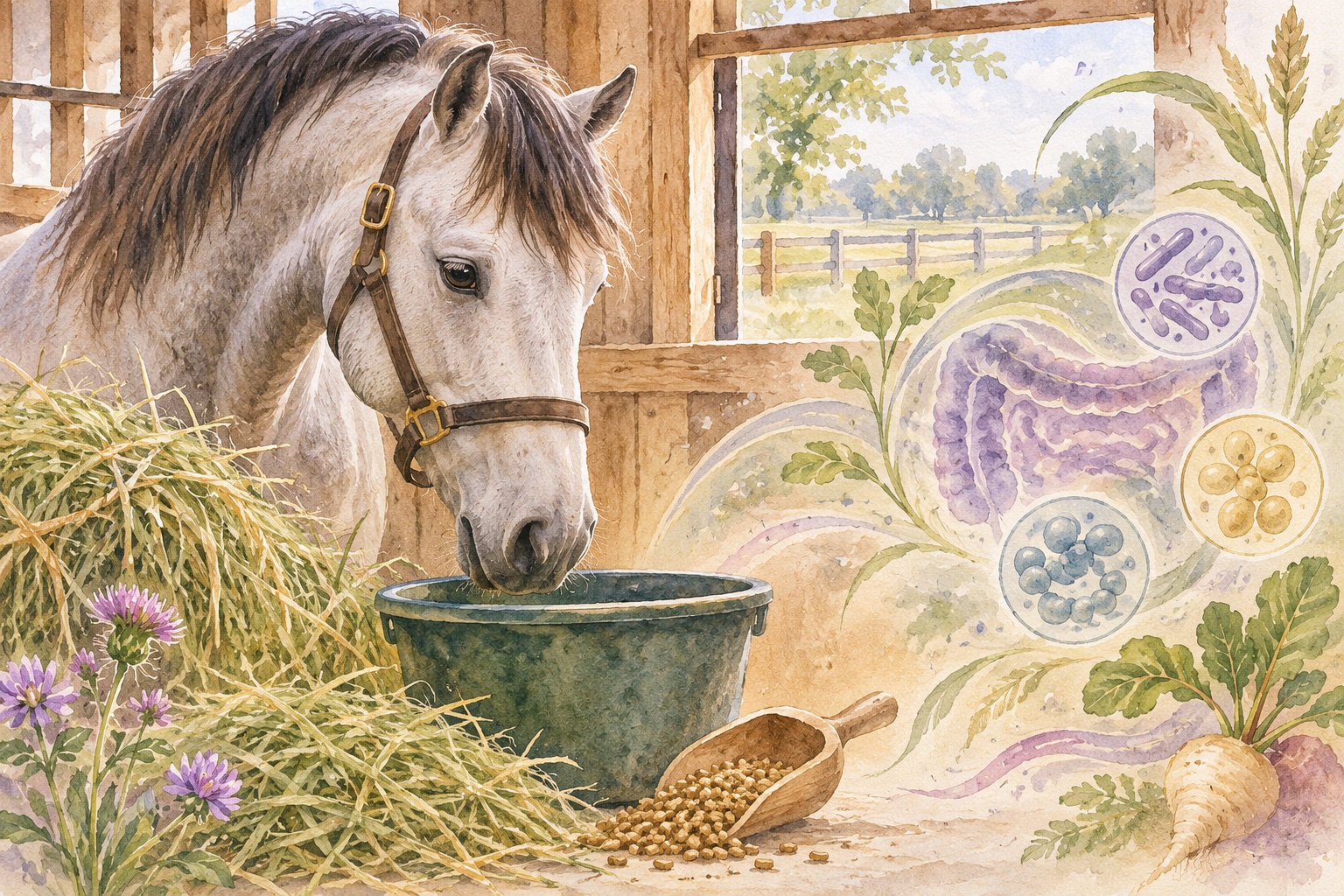
Start with forage
The first step is to analyze the forage, not to buy a supplement.
It is an unfashionable order of operations, and it is the correct one. Everything in the feed room sits on top of the hay, and hay is the largest, most variable, and least examined part of most rations. Timothy, teff and alfalfa — the three forages in our own barn — vary substantially in energy, protein, minerals and nonstructural carbohydrates, bale to bale and cutting to cutting. A hay analysis turns that variation into numbers you can feed by.
Our teff came back from the lab at 3.85 percent ESC and 1.41 percent starch, which is why it went to the easy keepers. Our timothy is leafier and richer, and goes where it suits. Neither decision was available to us before the analysis existed. I have written about both forages at length — why I tried teff hay and why timothy is the gold standard — and about building the whole ration on forage in An Anti-Inflammatory Diet Built on Forage.
Easy keepers need enough forage, and the essential nutrients forage carries, without the excess energy it can also carry. That sentence is the entire discipline of the anti-inflammatory feed room. The supplements below exist to serve it — not the other way around.
Why body condition matters
Adipose tissue is not inert storage. It participates in endocrine and immune signaling, and in the obese, insulin-dysregulated horse that signaling changes character — the subject of The Inflamed Easy Keeper in Volume I.
But honesty requires the second half of the sentence: equine obesity is not synonymous with proven systemic inflammation. Some fat horses show measurable inflammatory changes; many show none that we can find, and the markers we have are blunter than the marketing suggests — a caution Volume I examined in The Invisible Inflammation and Measuring the Invisible.
What is better established, and what this feed room is actually organized around, is the management of the insulin-dysregulated pony: dietary carbohydrate controlled, weight managed, laminitis risk taken seriously. An anti-inflammatory supplement protocol, as such, rests on thinner evidence than any of those three. The feed room works on the established things first.
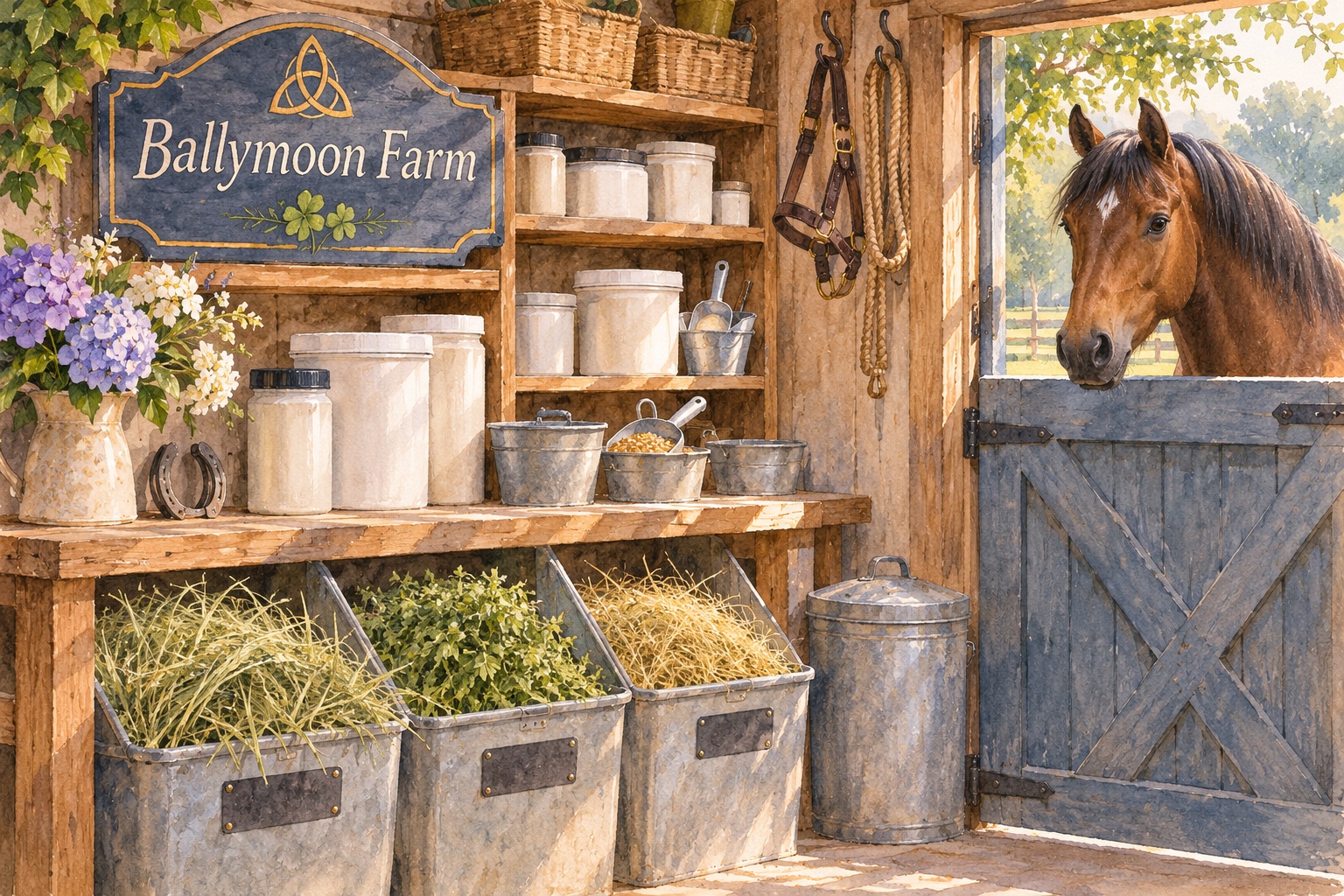
From the Ballymoon feed room
Here is what is actually on our shelves, and what each item is for. The list is shorter than the supplement aisle would like, and every entry has a named job.
The balancer. Mad Barn AminoTrace+, 200 grams a day for the horses on it, provides concentrated vitamins, minerals and amino acids in a serving whose calories an easy keeper can afford — formulated for metabolic horses, with no added iron and meaningful zinc and copper. It is the meal; the forage is the diet.
Disclosure: AminoTrace+ is a product I buy and feed myself, and the link above is my Mad Barn affiliate link — if you buy through it, I earn a small commission at no extra cost to you, and readers can use the code 5%-OFF-FROM-LISA-M.
The omega-3s. EO-3 and OmegaPrime+ supply long-chain omega-3 fatty acids — EPA and DHA — that a hay-based diet does not provide. They have different sources, different strengths and different jobs in this herd, and they get their own examination in the companion article, Omega-3s and the Horse: Beyond the Marketing Claims.
The senior feed. Triple Crown Senior, fed by the pound — a fortified feed for the horses whose teeth, age or condition ask for more than forage and a balancer alone.
The specifics. B-Pak provides B vitamins, and goes to one horse here: Ruby, our two-year-old filly, whose autumn parasite burden made B-vitamin support a reasonable part of her recovery ration. Monosodium phosphate provides phosphorus and sodium, fed where the forage analysis says phosphorus needs help. Iodized salt contributes sodium, chloride and iodine — an ounce a day, unglamorous and non-negotiable. GutBiome is a digestive-support formulation, also Ruby’s, and it is examined on the evidence in Probiotics, Prebiotics, and Yeast.
In practice, the whole system fits in two buckets. Our stallion, R Blue Moon, and Ruby share an identical ration: a pound of Triple Crown Senior as the carrier, the balancer, 30 grams of monosodium phosphate, 30 mL of EO-3, an ounce of iodized salt and 2.5 grams of zinc proteinate, over five pounds each of alfalfa and timothy. Our Thoroughbred mare and our senior horses get their senior feed weighed by the pound. And the five easiest keepers are on teff this autumn — about half a bale a day between them, weighed, because with this breed a flake is not a unit of measure.
These products have different purposes and are not a single universal ration. No horse here eats all of them. Each is fed to the horse whose record asked for it, at a stated dose, for a stated reason — and the reasons are reviewed, which is a subject this volume returns to before it ends.
The Connemara connection
A substantial, easy-keeping Connemara may have generous fat reserves while losing muscle. She can be, at the same time, over-supplied with energy and under-supplied with the amino acids, minerals and vitamins that energy-restricted rations quietly remove.
This is the breed’s oldest survival trait meeting its newest problem. The Connemara was shaped by sparse Irish grazing, weather and work — an animal built to thrive on forage that would leave other breeds thin. Put that thrift in a California feed room, in front of baled abundance, and the same efficiency that once kept her alive becomes the thing her owner must manage, meal by meal. Nothing in this feed room is an attempt to defeat her nature. It is an attempt to feed the nature she actually has.
So the assessments have to be made independently: muscle, body condition, dental health, metabolic status, and the forage analysis each tell a different part of the truth, and no one of them substitutes for the others. The aging version of this pony was Volume I’s subject in The Aging Easy Keeper.
Correcting a nutritional shortfall is useful, worthwhile work. It is not the same as treating a diagnosed inflammatory disease — and a feed room that understands the difference is worth more than one twice its size.
What the evidence says
Nutritional adequacy and diagnosis-directed management are established principles. Product-specific claims of reduced systemic inflammation should be treated as preliminary unless supported by controlled equine clinical trials.
That is the standard this volume holds itself to — in this article, and in every article that follows it.
Further reading
National Research Council. (2007). Nutrient Requirements of Horses (6th rev. ed.). The National Academies Press.
Equine Endocrinology Group. (2022). Recommendations for the Diagnosis and Management of Equine Metabolic Syndrome.
Durham AE, et al. (2019). ECEIM consensus statement on equine metabolic syndrome. Journal of Veterinary Internal Medicine, 33(2), 335–349. https://doi.org/10.1111/jvim.15423
Educational material only; not a substitute for veterinary diagnosis, medical treatment or individual ration formulation.
Ballymoon Farm
Connemara Sport Horses & Ponies
The Connemara Breeder’s Library — by Lisa Martin











For more of our latest photos and inspiration, follow along on instagram at @instapony_.
© Redbud Ranch 2020 | Connemara Sport Horses and Ponies | photos by Lisa Martin |
terms & Condtions |
privacy Policy
Intentionally Bred with People in Mind
Browns Valley, CA
+ Show / Hide Comments
Share to: