
What Your Pony’s Sire Line Can Tell Us: The Connemara Y-Chromosome Study, in Plain English
November 10, 2026


A study with a personal thread
This one has a personal thread for me. I was one of the people who sent in a mane hair sample for it, one of five from the United States. Researchers at the University of Veterinary Medicine in Vienna wanted to look at the Connemara pony through its father lines, and only through its father lines. That narrow view is exactly what makes the study useful, and exactly what its limits are. This article is my plain-English version of what they found, with the facts kept straight.
The study is a diploma thesis by Sophie Anja Jetzinger, finished in October 2026. It is one study, with 38 ponies. It is not the last word on the breed. But it is the first time all five of the breed’s living father lines have been checked this way, and what it found mostly confirms the old paper records, with three puzzles worth knowing about.
The one-sentence version
The Connemara’s father lines still carry four distinct genetic fingerprints, and two of them had never been found in Connemaras before. Both new ones match the history books: one points to Thoroughbred blood through Little Heaven, and one points to Arabian blood through Naseel.
First, what a “father line” means
Every stallion carries a Y chromosome, and he passes it to his sons almost unchanged. His daughters do not get it. So if you follow a colt’s pedigree up through his sire, his grandsire, his great-grandsire, and on up the top line only, you are following the Y chromosome. Breeders call that the tail-male line, or sire line.
Think of it like a family surname passed from father to son. It tells you one thread of a horse’s ancestry, and nothing about the rest. A pony gets half its genes from its dam, and the dam’s own sire line, her dam, and every other branch are invisible to this test. That matters for everything that follows. This study says nothing about mare lines, nothing about temperament or jumping ability, and nothing about how good any one pony is. A fingerprint is not a quality mark. None of the four fingerprints found is better than the others.
Because the Y chromosome barely changes except for rare small mutations, tiny differences in it act like a fingerprint for a father line. All the stallions in one true father line should share the same fingerprint. When they do not, either the paper record is wrong somewhere, or a different stallion covered the mare than the one written down. That is the detective work this study does.
What the researchers actually did
They collected mane hairs, roots included, from 38 male Connemara ponies in 10 countries: Ireland (10), New Zealand (7), the United States (5), Australia (4), Germany (4), Austria (3), the Czech Republic (2), and one each from Denmark, Norway, and Sweden. The ponies were chosen to cover all five father lines still active in the breed. The horses were anonymised in the study, each given a number instead of a name.
The DNA from the hair roots was first read with a genotyping chip that checks 170 markers on the Y chromosome, then a small number of follow-up tests pinned down each pony’s exact fingerprint. Using the chip first cut the follow-up testing from about 950 tests to 101, which is part of why a study like this is now practical at all.
One caution before the numbers: 38 ponies, chosen by pedigree, is not a census of the breed. The counts below describe this sample. They do not tell us what share of all Connemaras worldwide carry each fingerprint.
The breed in brief, as the thesis tells it
The Connemara comes from the rocky, hilly, partly marshy region of the same name on Ireland’s west coast. Ponies there are mentioned as a semi-feral population as early as 1399. For centuries they were all-purpose working ponies, pulling light carts and hauling turf, and ridden too. A small, sure-footed pony was what that hard ground demanded, and the breed still shows it: sturdy, self-reliant, willing to work, with a natural jump.
The Connemara Pony Breeders’ Society (CPBS) was formed in 1923, and the first studbook followed in 1926, listing 93 mares and nine stallions. The Irish studbook of origin closed in 1964, meaning no outside blood has been allowed into the purebred studbook since. The breed standard describes a compact, well-balanced pony, 128 to 148 cm (about 12.2 to 14.2 hands), deep-bodied with a strong back, short strong legs, hard level hooves, and a kind eye. Allowed colours include black, bay, chestnut, buckskin (dun), palomino, smoky black, the roans, and grey.
The breed spread worldwide after the Second World War, first to England, then across Europe. The thesis reports France as the largest Connemara population outside Ireland, and Ireland still the largest overall: 3,741 breeding mares and 463 approved stallions in 2024, and 3,284 foals born in 2025, up from 1,232 in 2015.

The five father lines
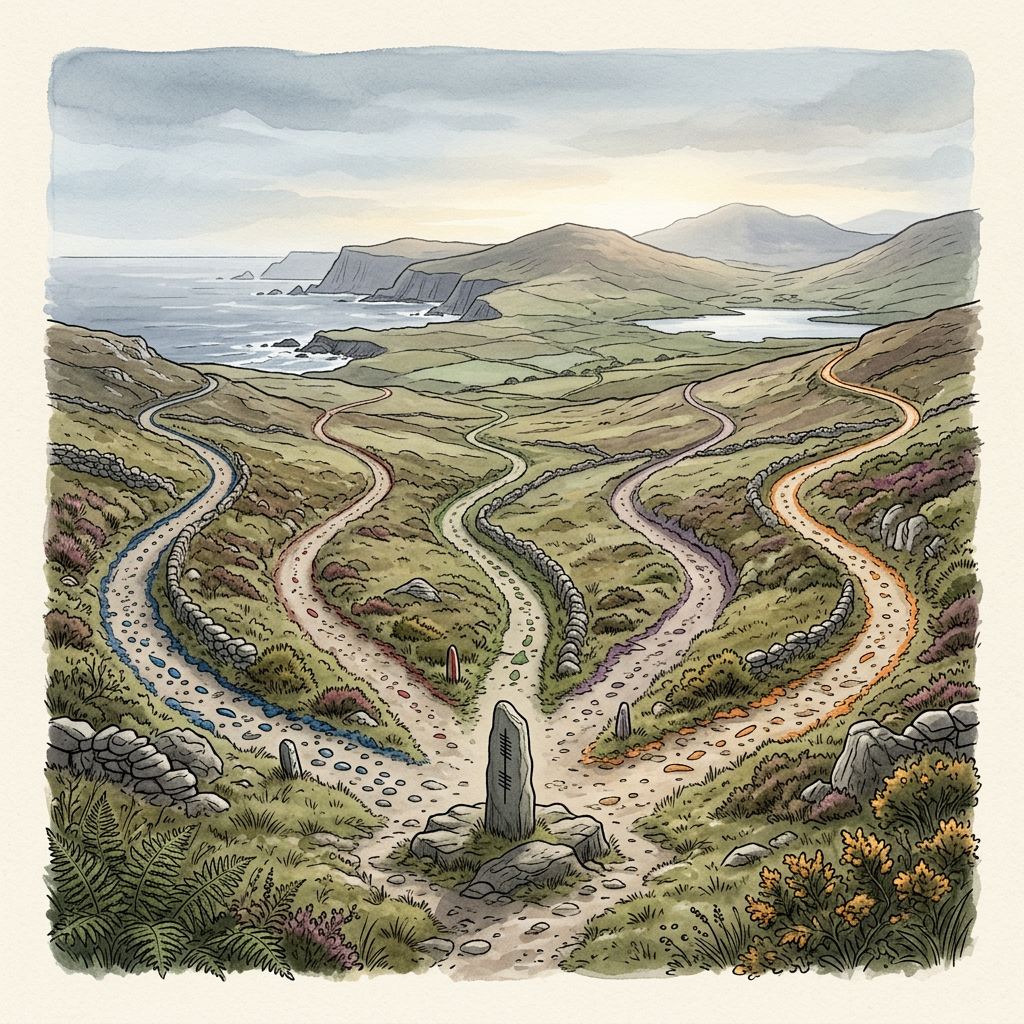
Seven father lines were recorded originally. Five are still active today. The other two, after Black Paddy (born 1916) and John Quirke (born 1923), have no active sires left. Breeders know the five living lines by their colours:
- Blue line — Cannon Ball (born 1904). A grey stallion, the first stallion in the Irish studbook, son of a Welsh cob-type stallion out of a Connemara mare. A regular winner in local races, known for endurance and intelligence. His son Rebel was his most influential offspring.
- Red line — Connemara Boy (born 1922). A grey stallion, the ninth in the studbook, bought by the CPBS. He won the Irish stallion class in 1926, 1930, and 1931, and was valued for hardiness and stamina. He died in 1940 of tetanus.
- Green line — Mountain Lad (born 1928). Taken from a half-feral herd because the CPBS worried the breed’s genetic base was too narrow and wanted a stallion unrelated to the first two lines. Records variously call him grey or chestnut, which tells you something about how fuzzy early records can be. He died in 1939, a year after leaving his half-feral life.
- Purple line — Little Heaven (born 1942). A small English Thoroughbred, bought by the CPBS in 1946 to make the ponies taller and more athletic. He bred until 1951 and was castrated in 1952 after a cataract was found. His sons included Carna Dun and Texas Hope, who went to the United States.
- Orange line — Naseel (born 1936). An Arabian stallion, white-grey and of moderate height. The CPBS never registered Naseel himself, but registered his son Clonkeehan Auratum (born 1954), a cautious way of bringing Arabian blood in. Sixteen of Clonkeehan Auratum’s sons went on to be registered breeding stallions.
The four fingerprints they found
Each fingerprint has a code name. The codes are just catalogue labels, so do not worry about memorising them. What matters is which lines carry which fingerprint, and what other breeds share it.
- daC_Ad-bA — 14 of 38 ponies (37%). The most common fingerprint in this sample. It was the main fingerprint of the Mountain Lad line (all 4 sampled) and of the Cannon Ball line (10 of 13). Researchers link it to British and Irish pony breeds, including the Dales, Dartmoor, Fell, Highland, and Kerry Bog ponies, and describe it as Spanish-derived. That fits the old story of Spanish horses reaching Ireland through trade in the 14th to 17th centuries. It does not prove the Spanish Armada shipwreck legend. The thesis does not claim that, and neither should we.
- daC_Tb-oB1 — 10 of 38 (26%). The main fingerprint of the Connemara Boy line (7 of 8). It is also found in Turkoman horses, some Arabians, and in the line of Byerley Turk, one of the Thoroughbred’s foundation sires. No paper records survive for Connemara Boy’s own ancestry, so this fingerprint is the only clue we have to where his line came from, and it points east, toward Thoroughbred, Arabian, or Turkoman roots.
- daC_Tb-dW1 — 9 of 38 (24%). New for Connemaras. The main fingerprint of the Little Heaven line (8 of 9). This fingerprint is a clear Thoroughbred marker, traced to Whalebone (born 1807), who appears in Little Heaven’s recorded pedigree. Finding it here genetically confirms what the paper record already said: Thoroughbred blood came in through Little Heaven and is still there.
- daC_Ao-aA1a3 — 5 of 38 (13%). New for Connemaras. Every sampled pony in the Naseel line carried it (4 of 4). It matches the fingerprint previously found in Arabian horses, including Ibrahim (born 1899), a paternal ancestor of Naseel. Again, the DNA confirms the paper record: Arabian blood came in through Naseel and is still there.
Ireland was the only country in the sample where all four fingerprints turned up, which makes sense. It is the breed’s home, and it supplied the most samples (10). Germany’s four samples all carried one fingerprint, and Austria’s three all carried another, but with samples that small, that likely says more about which lines were sampled in each country than about the whole population there.
Three paper-trail puzzles
In three of the five lines, the DNA split where the paper record says it should not. The study treats these as possible pedigree inconsistencies, not proven errors. In the 1930s to 1960s, stallions travelled between farms, mares were covered where they stood, and records were kept by hand. A mix-up was easy, and none of this is a criticism of anyone alive today.
- The Cannon Ball line splits in two. Ponies tracing to Cannon Ball’s son Inishgoll Laddie carried the blue line’s usual fingerprint, while ponies tracing to his son Lavelley Rebel carried the red line’s fingerprint. Two stallions said to be paternal half-brothers cannot both be right. The thesis notes that Lavelley Rebel was raised with other 1935 colts at the same place, including two recorded sons of Connemara Boy, and suggests the colts may have been confused.
- One branch of the Connemara Boy line carries the Little Heaven fingerprint. An Australian pony tracing through Macdara’s son Murrisk carried the Thoroughbred fingerprint most common in Little Heaven’s line, while the branch through Macdara’s other son carried the expected fingerprint. The study speculates that an unrecorded Little Heaven-line sire sits somewhere in Murrisk’s line. It also notes that Murrisk’s grandson Bengt was a notably good sire though his sire was described as plain, a mismatch the author of the older breed histories had already wondered about.
- One branch of the Little Heaven line carries the Naseel fingerprint. Six of seven branches after Carna Dun carried the expected Thoroughbred fingerprint. The branch through Camlin Cicada (born 1959) carried the Arabian fingerprint found in Naseel’s line. The thesis builds a careful circumstantial case: Carna Dun was stationed about 60 km from Camlin Cicada’s dam when she was covered, while Clonkeehan Auratum, Naseel’s son, was stationed in the same area at the same time, and a 1958 photograph shows him standing next to the dam. That is suggestive, not proof. Only more testing of descendants could settle it.
There is one more date puzzle the thesis flags in passing: three stallions listed as Mountain Lad’s sons were foaled after his recorded death in 1939, so they cannot all be his sons as recorded. Old studbooks deserve respect, and also a second look.
Honest limits
A few things this study cannot tell us, stated plainly so nobody over-reads it:
- It says nothing about the dam’s side, which is half of every pedigree and, in my experience, where a great deal of what makes a pony is decided.
- It says nothing about quality, temperament, jumping ability, or soundness. A fingerprint does not make a sire good or bad.
- It says nothing about HWSD or any other health condition. That is a different gene and a different test, and the carrier rule for HWSD stands exactly as before.
- The percentages are for these 38 ponies, not for the breed. A bigger sample, especially from France, the largest population outside Ireland, could shift the picture.
- One sample could not be confirmed to the final step and was counted on chip and pedigree evidence. The study is open about that, and so am I.
Why it matters to the rest of us
First, it is reassuring. The two new fingerprints did not come out of nowhere. They landed exactly where the history books said they should, which means the old records, for all their fuzziness, were broadly right about Thoroughbred and Arabian blood shaping this breed.
Second, it is a reminder to keep all five lines alive. A breed that narrows itself to one fashionable father line loses options it cannot get back. The studbook closed in 1964, so what is here now is what we have. Knowing which lines carry which fingerprint helps breeders avoid accidentally doubling up on one line while thinking they are outcrossing.
Third, it gives us a practical habit: when you read a pedigree, follow the top line all the way up. Sire, grandsire, great-grandsire. Which of the five lines is it? Then remember that is one thread only, and go and look at the dam, the dam’s sire, and the ponies themselves. Paper, DNA, and the pony in front of you are three different kinds of evidence, and the wise breeder uses all three.
The Connemara was shaped by hard ground, hard weather, and the horses many different people brought to that corner of Ireland: Celtic ponies, Spanish horses, Welsh cobs, Thoroughbreds, Arabians, and more. This study adds one more record to the shelf beside the old studbooks, written in a language most of us never learned. Translated, it says something breeders have always known: the breed is a mixture, the mixture is the point, and the records are worth checking, because the ponies remember what the paper forgot.
A note on our own stallion: R Blue Moon’s sire line runs through his sire, Wildwych Eclipse, and his grandsire, Glenormiston Flurry Knox. Blue was not one of the 38 ponies in this study, and his Y-chromosome fingerprint has not been published, so this article doesn’t assign him to one of the four fingerprints above. To meet him, see R Blue Moon’s page.
Source: Sophie Anja Jetzinger, “Y-chromosomal lineages as a window into the breeding history of the current Connemara pony population,” diploma thesis, University of Veterinary Medicine Vienna, October 2026. Simplified here for general readers; figures and fingerprint codes are the study’s own.
— Lisa Martin, Ballymoon Farm, Browns Valley, California






For more of our latest photos and inspiration, follow along on instagram at @instapony_.
© Redbud Ranch 2020 | Connemara Sport Horses and Ponies | photos by Lisa Martin |
terms & Condtions |
privacy Policy
Intentionally Bred with People in Mind
Browns Valley, CA
+ Show / Hide Comments
Share to: