


By Lisa Martin, Ballymoon Farm
Feed the mare in front of you, at the stage she is actually in. That sounds obvious, but broodmare feeding goes wrong in predictable ways: feeding “for two” from the positive scan, reaching for a broodmare mix when all she needed was a balancer, and forgetting that the biggest nutritional event of the year is not pregnancy at all — it is lactation. Here is what the current evidence says, stage by stage, for a mare of about 1,100 lb. The requirement system behind these numbers is still the NRC’s Nutrient Requirements of Horses (2007) — there is no newer edition — with university extension and research groups arguing, openly, about optimums above the minimums for a handful of nutrients. Where they disagree, I say so.
Condition first, calories second
Breed at body condition score 5 to 6 on the 9-point scale, and foal at the same. Every source agrees on this. Mares below 5 conceive less readily and cycle later; mares at 7 and above carry metabolic risk, and research on obese mares shows their foals can be insulin-resistant and inflammation-prone even when the placenta itself looks normal. If an easy keeper needs to slim down, do it before breeding. Pregnancy is not the time for a diet: no weight-loss programme in the first 60 days or the last 90 days of gestation.
The numbers, stage by stage
| Per day, 1,100 lb mare | Maintenance | Mid gestation (mo 7–8) | Late gestation (mo 11) | Early lactation (mo 1) |
|---|---|---|---|---|
| Digestible energy | 16.7 Mcal | 17.9–18.5 Mcal | 21.4 Mcal | 31.7 Mcal |
| Crude protein | 630 g | 729–759 g | 893 g | 1,535 g |
| Lysine | 27 g | ~31 g | ~38 g | 84.8 g |
| Calcium | 20 g | 28 g | 36 g | 59.1 g |
| Phosphorus | 14 g | 20 g | 26 g | 38.3 g |
| Copper | 100 mg | 100 mg | 125 mg | 125 mg |
| Zinc | 400 mg | 400 mg | 400 mg | 500 mg |
| Selenium | 1 mg | 1 mg | 1 mg | 1 mg |
| Vitamin A | 15,000 IU | 30,000 IU | 30,000 IU | 30,000 IU |
| Vitamin E | 500 IU | 800 IU | 800 IU | 1,000 IU |
Read the shape of that table, because the shape is the lesson. Through mid gestation, almost nothing moves. Late gestation is a protein and mineral problem more than a calorie problem: energy rises about 28% over maintenance, but protein rises 42%, calcium 80%, phosphorus 86%. Then lactation is the cliff — energy up 90%, protein up 144%, lysine up more than 200% over maintenance.
Months 1–8: change almost nothing
Energy and protein needs barely rise until month 5, and minerals not until about month 7. What does change at conception is vitamins A and E, which step up immediately — one reason a broodmare balancer should already be in place at breeding, not introduced at month 9. For an easy keeper, this phase is an exercise in restraint: tested low-NSC hay, weighed rather than free-choice if she gains easily, a ration balancer at the broodmare rate on the label, salt, and a condition score every two to three weeks. Scale weight rising in early gestation in an easy keeper is fat, not foal — most of the 130–175 lb a mare gains across pregnancy is foetus, placenta, fluids and udder, and nearly all of it arrives in the last trimester.
The last 90 days: density, not volume
Roughly two-thirds or more of foetal growth happens in the last trimester, while the foal is taking up room the gut used to have. So the answer is nutrient density in smaller meals, not bigger feeds. The trace minerals matter here for a reason many people miss: the foal stores copper, zinc, iron and manganese in its liver before birth, because mare’s milk is very low in them. What the mare eats in the last trimester is, quite literally, the foal’s first mineral supply.
For an easy keeper, the step-up usually looks like this — a worked example for an 1,100 lb mare in month 10, on tested grass hay at about 10% protein:
- 20 lb tested grass hay, split day and night, in a slow-feed net
- 3 lb alfalfa hay — lifts protein, lysine and calcium density without starch
- 2 lb stud/broodmare ration balancer, split into two meals — this is what carries calcium, phosphorus, copper, zinc, selenium, iodine and vitamins A and E to target
- 1 oz loose salt, plus free-choice plain salt
That lands at roughly 19–21 Mcal with protein comfortably above target. If her condition rises toward 7, cut the alfalfa first. If she slips below 5.5, add fat and fibre — rinsed beet pulp, a little oil — before reaching for any cereal feed. The 6–14 lb of broodmare mix on the bag label is written for moderate and hard keepers; an easy keeper rarely needs it, and feeding a fortified feed at a token rate is its own error, because she then gets a fraction of the fortification too.
Lactation: the real feeding season
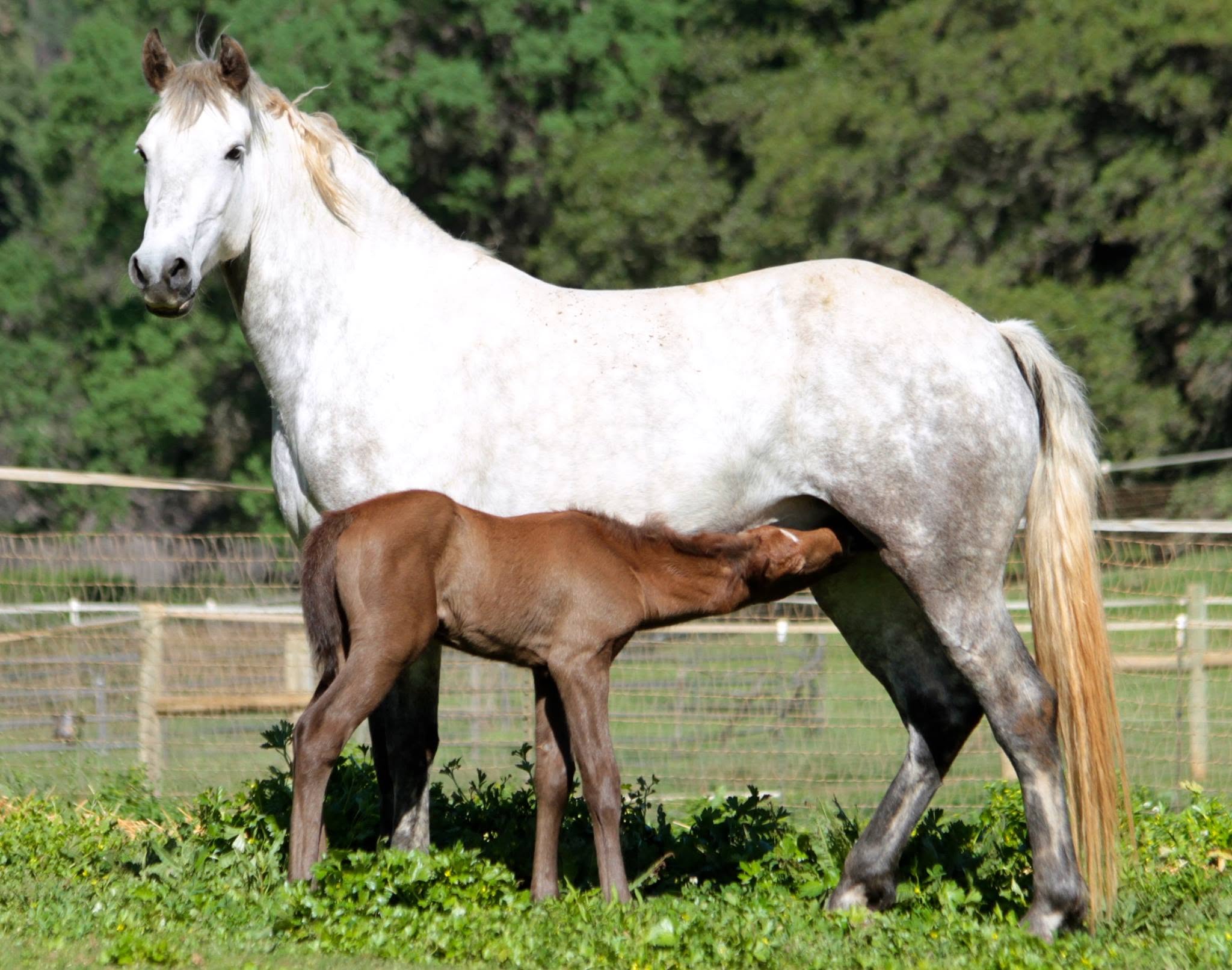
A mare in the first month of lactation needs close to double her maintenance energy, and even an easy keeper will usually need more than hay and balancer for the first 60–90 days. The order of operations matters: better forage first (a grass/alfalfa mix, offered freely), the full balancer, then a low-NSC fat-and-fibre feed in small meals, adjusted weekly against her condition. A starting point for the same mare:
- 18 lb grass hay, free-choice
- 6 lb alfalfa hay
- 2 lb stud ration balancer, split into two or three meals
- 4 lb low-NSC broodmare or fat/fibre feed, split into two or three meals, none over 2 lb
- 2 oz loose salt, and water checked twice a day — a lactating mare can drink well over 20 gallons
Some condition loss in early lactation is normal — that is what foaling at a 6 is for. If she holds 5.5–6 and the foal is thriving after two weeks, trim the concentrate to 2–3 lb; that is the expected easy-keeper outcome, because native mares generally milk below the yields the textbook tables assume. If she drops half a score or more, add feed in 1 lb steps and check teeth, worming and hay quality before assuming she needs grain. From month three or four, taper the concentrate first, then the alfalfa.
Two warnings that are not optional
Fescue. Mares on endophyte-infected tall fescue — pasture or hay — risk prolonged gestation, thickened placenta, difficult foaling and no milk. You cannot tell by looking; the forage must be tested. Remove pregnant mares from infected fescue 60–90 days before foaling.
Placentitis is not a feeding problem. No diet or supplement prevents or treats it. It is overwhelmingly an ascending bacterial infection; prevention is perineal conformation and a Caslick where indicated, monitoring, and early veterinary treatment. Good selenium and vitamin E status supports general immune function, and that is where nutrition’s role honestly ends.
The Connemara twist
Everything above comes with one honest caveat: there are no Connemara-specific feeding trials. Every number in this article is light-horse research scaled by bodyweight, and the steering wheel is body condition, not the table. That matters more for this breed than most, because the Connemara was shaped by poor Irish hillsides — sparse grazing, hard weather, work on little. Thrift is not a flaw in these ponies; it is the breed. The predictable modern problem is not underfeeding but overfeeding: obesity, insulin dysregulation and laminitis are the native pony diseases of plenty.
Three practical consequences follow. First, the lactation tables almost certainly overestimate a native mare — Connemaras generally milk below the Thoroughbred-derived yields the NRC equation assumes, so expect to land under the textbook concentrate amounts and let her condition and the foal’s growth set the dose. Second, meals are pony-sized: split concentrates small and often, roughly 2 lb at a time for an 1,100 lb mare and less for a smaller pony. Third, the easy-keeper toolkit — weighed low-NSC hay rather than free-choice, slow-feed nets to stretch it, a balancer instead of a bag feed, grazing muzzles in the flush season — is not a compromise for this breed. It is feeding the pony the way her genetics expect to be fed.
Companion reading: this article is the practical half of our full research review, Feeding Broodmares: Latest Research, and pairs with Broodmare Supplements: What the New Research Actually Shows.
Sources
National Research Council, Nutrient Requirements of Horses, 6th rev. ed. (2007), as tabulated by Mad Barn, “How to Feed a Pregnant Mare,” and the MSD Veterinary Manual’s lactating-mare requirement table. Lawrence & Camargo, University of Kentucky, “Feeding the Broodmare: Four Easy Steps.” University of Minnesota Extension, “Caring for your mare during breeding and foaling.” Iowa State University Extension, “Nutrition for the Gestating and Lactating Mare” (AS19, 2021). Kentucky Equine Research, “Nutrition of Mares in Late Pregnancy” and “Feeding an Overweight Pony Broodmare.” Penn State Extension, “Tall Fescue: Potential Problem for Pregnant Broodmares.” Colorado State University, “Placentitis in Mares” (2025). Robles et al., Veterinary Sciences (2023) on maternal obesity and the placenta.

Previous Post
Next Post




For more of our latest photos and inspiration, follow along on instagram at @instapony_.
© Redbud Ranch 2020 | Connemara Sport Horses and Ponies | photos by Lisa Martin |
terms & Condtions |
privacy Policy
Intentionally Bred with People in Mind
Browns Valley, CA
+ Show / Hide Comments
Share to: