
Gut Health Without the Hype: Postbiotics, Probiotics, and What I Feed My Horses
November 11, 2026


Affiliate disclosure: This post contains affiliate links. If you buy through my Mad Barn shop link, I may earn a small commission at no extra cost to you. Use code 5%-OFF-FROM-LISA-M at checkout for 5% off. I only link products I actually use.
Gut Health Without the Hype: Postbiotics, Probiotics, and What I Feed My Horses
“Microbiome” is the word everyone is hearing right now. There are microbiome testing kits, microbiome probiotics, and microbiome feeds, and most of the advertising talks as if the word itself were the treatment.
It is not. The word describes something real and useful, and then the advertising runs ahead of the evidence. This post is my attempt to sort out the words, tell you what I actually feed, and be honest about what gut support can and cannot do.
What the Microbiome Actually Is
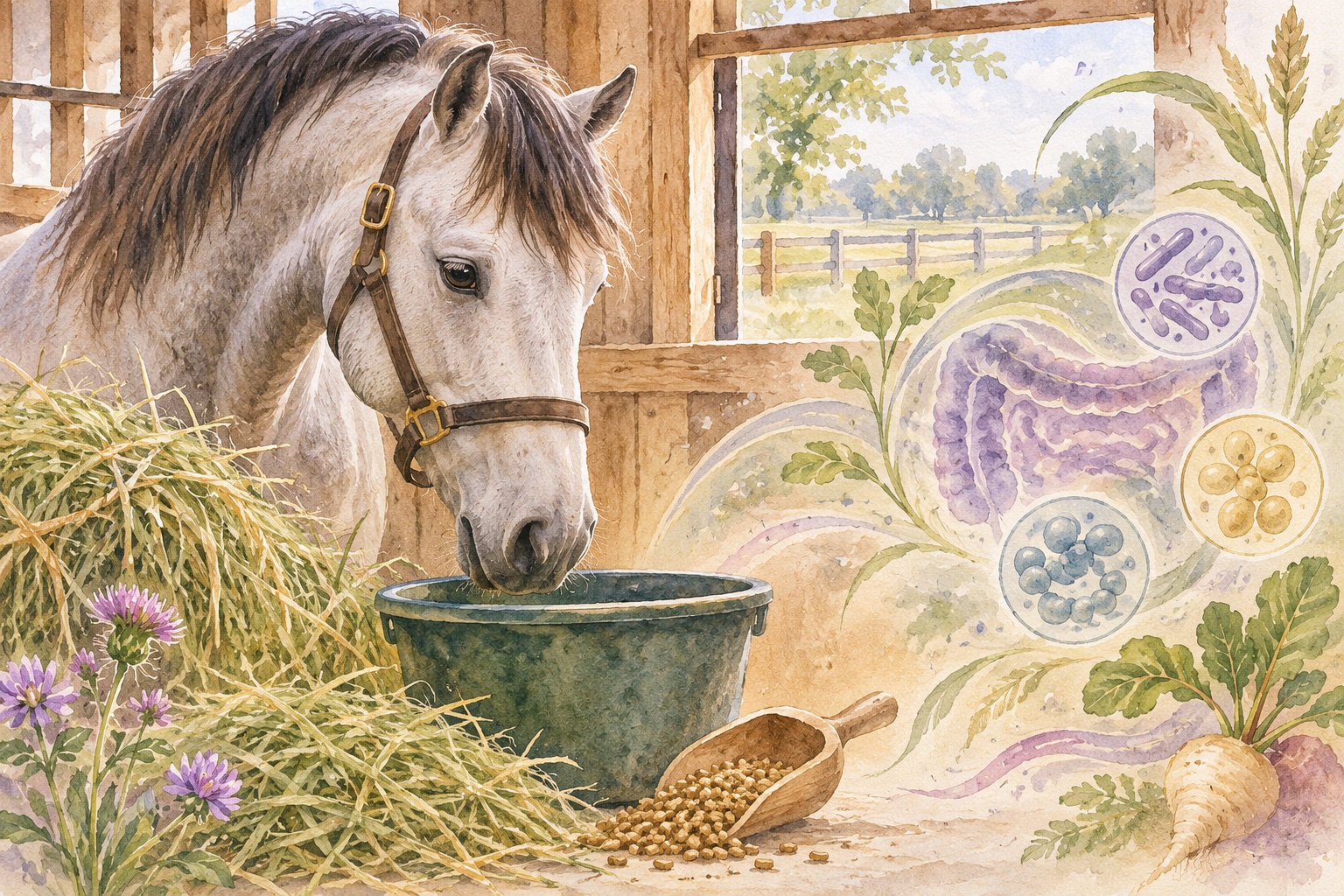
A horse is a hindgut fermenter. That is a plain way of saying that most of a horse’s energy from forage does not come from the horse digesting the hay directly. It comes from the microbes in the hindgut fermenting fiber and turning it into slow, steady energy the horse can use.
Those microbes need three things to stay steady: a steady supply of fiber, slow changes, and no big spikes of starch overwhelming the hindgut. Sudden feed changes, large high-starch meals, and inconsistent timing disturb them. When the hindgut is disturbed, the horse tells you: manure changes, appetite changes, attitude changes, condition changes. The gut is not a separate system from the horse. It is the engine room.
That is why “gut health” is not really a supplement category. It is a feeding-management category first, and a supplement category second. Forage, routine, small meals, and slow transitions do more for a hindgut than any tub. A tub on top of chaos is still chaos.
Prebiotic, Probiotic, Postbiotic — Sorted Out
The words get used as if they were interchangeable. They are not.
A prebiotic is food for microbes: fiber and fermentable carbohydrates that feed the hindgut population. Good forage is, in effect, a prebiotic. You are already feeding one if you are feeding hay well.
A probiotic, or live yeast, is a live organism fed to the horse — most commonly live Saccharomyces cerevisiae yeast. It has to survive the stomach to do anything in the hindgut, and its effect depends on the strain, the dose, and the horse.
A postbiotic, or fermentation product, is not live. It is the yeast culture plus what the yeast produced during fermentation — the metabolites, cell fragments, and fermentation products. TruEquine, made by Diamond V, is a postbiotic of this kind: a Saccharomyces cerevisiae fermentation product. Because it is not live, it is heat-stable and it does not need to survive anything. It is a different tool from a live probiotic, not a better or worse one. Different.
There is a fourth thing you will see on labels: yeast cell wall / MOS (mannan-oligosaccharides), fragments of yeast cell wall that can bind certain things in the gut. It is often in the same products as live yeast. It is worth knowing the name so you can read a label and see what is actually in the tub, instead of guessing from the front of the bag.
If a product says “gut health” on the front and you cannot tell from the ingredient list whether it contains a prebiotic, a live probiotic, a postbiotic, or yeast cell wall, that is information too. It tells you the label is selling a feeling, not a formula.
What I Feed
Ruby, my 2-year-old Connemara Thoroughbred filly, gets ProElite GutBiome at 40 grams a day. That is the full label dose for a 1,000-pound horse, and Ruby tapes at about 1,128 pounds, so she is getting her full dose, not a partial one. GutBiome’s headline ingredient is the TruEquine postbiotic, at 12,000 mg per 40-gram serving.
Ruby also gets AminoTrace+ as her balancer, and AminoTrace+ itself carries yeast and MOS — not TruEquine specifically, but a yeast route of its own. So Ruby has postbiotic cover from GutBiome and yeast plus MOS cover from her balancer. I do not add a third yeast product for her. Two routes is coverage. Three is stacking, and stacking tells you nothing about what is actually doing anything.
The rest of the herd is in transition. For years they were on Symphony, an all-in-one supplement from A Horse of Course, and the TruEquine postbiotic in Symphony is the part I wanted to keep. I love that ingredient. The herd is moving to AminoTrace+ as the balancer, and AminoTrace+ carries yeast and MOS, so whether each horse still needs a separate TruEquine product after the switch is a decision per horse, not a blanket rule.
That switch has not finished yet. I have Symphony bags to use up first, then a taper, then the switch — and the exact date is not set. I am not going to write about the new program as if it were already the program. It is not. This article describes what Ruby gets now and what the herd gets now, and I will update it when the switch is real.
What Gut Support Did Not Do
Ruby is still recovering. She had a parasite-induced malabsorption problem, a fractured hip around weaning, a popped splint, cracked and flared feet, and a coarse, bleached coat. She is better since she was dewormed in October, her coat looks a little better, her hay belly is better, and her feet are tighter. She is making remarkable, steady progress right now.
Gut support did not heal her. Deworming, time, feed, and a ration built for recovery did the heavy lifting, and even now her recovery is uncertain. I have said before that time will tell whether she fully recovers, and I mean it. A postbiotic is support. It is not treatment for parasite damage, and it is not a reason to skip a vet, a fecal count, or a deworming plan. If your horse has weight loss, diarrhea, colic, or a coat and feet falling apart, that is a vet conversation first, not a supplement conversation.
The same goes for colic and ulcers. Gut products are talked about as if they prevent both. They do not, on their own. Management prevents most of what is preventable: forage, water, routine, slow changes, dental care, and not leaving a horse standing with an empty gut. A tub helps a good program. It does not rescue a bad one.
The Broodmare Caution
This one stays in, in plain language, because it matters and it is easy to miss.
GutBiome’s label does not prove safety in pregnant or breeding animals. That does not mean it is unsafe. It means the safety has not been proven for that use, and I do not carry a product over to a broodmare on an assumption. For a mare being bred, use a broodmare-labeled product and vet advice, and do not assume that what is fine for a growing filly is fine for a pregnant mare.
The same rule applies to any gut product, any balancer change, and any new supplement in a breeding program: check the label, check with the vet, and do not stack products because each one looked good on its own.
Microbiome Testing Kits
You will see kits that test your horse’s manure and report on the microbiome. Here is what I think of them, as someone who has not used one.
A kit gives you a snapshot, not a diagnosis. It can tell you something about the microbial population on the day the sample was taken, and that can be interesting. It cannot tell you, on its own, what to feed, what caused a problem, or whether a supplement worked. Manure microbes shift with diet, stress, season, and sampling, and a single snapshot without a vet and a feeding history behind it is easy to over-read.
If you use one, use it as a question to take to your vet or nutritionist, not as an answer you act on alone. And if a company tells you the test proves you need their product, that is sales, not science.
When Gut Support Earns Its Keep
In my barn, gut support earns its keep at stress points: weaning, transport, a diet change, and recovery. Those are the moments when the hindgut is most likely to be disturbed, and when steady support makes the most sense.
Routine daily use for every horse, forever, is a different claim, and I am more cautious about it. A horse on steady forage, steady routine, and a balanced ration may not need a daily gut product at all, and I would rather spend that money on hay analysis and a balancer I understand than on a tub for every horse out of habit.
For foals, I am more cautious still. Routine probiotics for newborn foals are not a default in my program, and the evidence for neonatal use is mixed. Vet advice first, always, for anything that young.
Do Horses Need a Probiotic Every Day?
That is the question behind all of this, and my answer is: some horses, some of the time, for a reason you can name.
If you can name the reason — a diet change, a stressful move, a recovery, a horse whose manure falls apart every time anything changes — then a gut product is a reasonable tool, fed one at a time, at the label dose, while you watch manure, appetite, coat, and condition. If you cannot name the reason, and the horse is thriving on forage, routine, and a balancer, then you probably do not need one, and the money is better spent elsewhere.
Keep notes with dates. Manure, appetite, coat, condition, and what changed and when. Memory is generous and notes are not, and gut changes are slow enough that you will not remember what you fed three weeks ago unless you wrote it down.
What I Feed, In One Place
- Ruby: ProElite GutBiome, 40 grams a day, TruEquine postbiotic.
- Ruby and the herd: AminoTrace+ balancer, carrying yeast and MOS, from Mad Barn — use code 5%-OFF-FROM-LISA-M at checkout for 5% off.
- Herd, in transition: Symphony bags to use up, then taper, then switch. TruEquine is the ingredient I want to keep, and the post-switch plan per horse is still to be decided.
- No third yeast product for Ruby. No daily probiotic for every horse by default. No microbiome test kit used.
That is the whole list. It is not very long, and I like it that way. The hindgut runs on forage and routine, and everything else is support for the program, not a substitute for it.
— Lisa Martin, Ballymoon Farm, Browns Valley, California







For more of our latest photos and inspiration, follow along on instagram at @instapony_.
© Redbud Ranch 2020 | Connemara Sport Horses and Ponies | photos by Lisa Martin |
terms & Condtions |
privacy Policy
Intentionally Bred with People in Mind
Browns Valley, CA
+ Show / Hide Comments
Share to: