


What I Mean by Temperament
When I say temperament, I mean something specific, and it is worth spelling out, because the word gets used to cover everything from “quiet” to “sweet” to “a bit dull.”
A good-minded horse thinks before it panics. It notices something new, it checks it, and it settles. It is easy to handle on the ground: caught, led, groomed, shod, loaded, and stood tied without a fight. It is sensible under saddle, which is not the same as slow. Sensible means the horse keeps its head when things change, a different arena, a new horse on the trail, a banner flapping where there was not one yesterday.
And it has a strong sense of self-preservation. I want a horse that looks after itself and its rider. I do not want a silly horse, one that runs through a fence, spins at its own shadow, or jumps off a bank without looking. Self-preservation is not cowardice. It is the opposite. It is a horse that meets the world with its brain switched on.
That is the standard I hold for every horse I breed, keep, or sell. It outranks upper-level potential whenever the two conflict. I would love to breed an upper-level pony, and I have said so honestly. But I will not chase that goal by breeding a horse that only a professional can ride. Most of my buyers are amateur riders. They are the people who actually buy horses, ride them every day, and keep them for years. A horse that an amateur can ride, enjoy, and trust is worth more to me, and to them, than a horse with a bigger engine and a smaller margin for error.
How Temperament Shows in a Young Horse
You cannot judge temperament from one good day. You judge it over time, in ordinary handling, and in first experiences.
I watch how a youngster is caught and led, how it stands for the farrier, how it loads, how it meets something new on the ground. I watch how quickly it settles after a fright, because every young horse spooks. The question is never whether it spooks. The question is what happens in the ten seconds after.
Under saddle, I watch the same things. A young horse I started recently, R Sparrows Zephyr, was lunged and then taken on a trail ride, and I called her maybe the bravest youngster I have started, smart but super level-headed. That is what I am describing: a young horse that met new things, thought about them, and kept going. She was not dull. She was paying attention, and she chose the calm answer. That is the kind of brain I want to breed on from.
I also watch my stallion. R Blue Moon is a pretty chill horse to live with, and that matters to me as much as anything on his pedigree page. A stallion’s temperament is in every foal’s daily life, through handling as much as through inheritance, because the foals that grow up calm are the ones that get handled often, started kindly, and sold to good homes. Temperament is partly inherited and partly made, and I take both halves seriously.
What Temperament Is Not
Temperament is not the same as quiet. A horse can stand like a statue because it has shut down, and that is not a good mind. I want a horse that is awake, interested, and responsive, and still sensible. Alert and calm belong together. If you have to choose between a horse that is bright and a little sharp and a horse that is dull and safe, neither one is quite what I am after. I want bright and safe, and I am willing to wait for it.
Temperament is also not an excuse. A well-bred, good-minded horse still needs consistent handling, fair training, and enough work to keep it occupied. Breeding gives a horse its starting point. Management decides how far that starting point takes it. A good brain left unhandled for two years will not present as a good brain. That is a management failure, not a breeding one, and I say that as a breeder, because it is the part of the job nobody can buy their way out of.
And temperament does not guarantee anything else. A kind horse can still be unsound. A sensible horse can still be the wrong size, the wrong mover, or the wrong match for a particular mare. Temperament is my first filter, not my only one. It is the gate a horse has to pass through before I ask the other questions.
What It Means for Buyers
If you are buying, temperament is the part you can check yourself, and you should. Watch the horse be caught, groomed, tacked up, and ridden by someone else first, and then ride it yourself if you can. Watch how it behaves away from its friends, and how it behaves when something ordinary goes a little bit wrong, a gate bangs, a dog runs past, the wind gets up. Ask how the horse lives day to day: alone or in a group, stabled or out, handled by one person or several. A horse that is only calm in one routine, with one person, in one place, has not yet shown you its temperament. It has shown you its routine.
Ask the breeder what they select for, and listen to the order they put things in. If temperament comes first in the answer, that tells you something about the horses. If it comes last, after the show record and the bloodlines, that tells you something too.
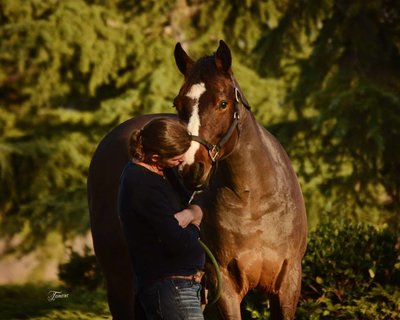
For my own buyers, mostly amateurs, I say this plainly: the horse you can ride on a Tuesday after work, in the rain, when you are tired, is the horse that will teach you the most and last the longest. The horse that needs a professional to hold it together is not a bargain at any price, because the price is not the purchase price. It is the training bill, the confidence you lose, and the day you stop riding altogether.
The Short Version
Bloodlines, heritage, and horsemanship: that is the tagline on my farm, and temperament is the horsemanship part made real. I breed for a horse with a good mind, a sensible outlook, and a strong sense of self-preservation, because that is the horse an amateur can ride, a family can keep, and a rider can grow with. Everything else I select for comes after that gate, and nothing I select for goes through it first. If a mating would give me more talent and less brain, I do not make it. I have never regretted that rule, and I do not expect to start now.
Previous Post
Next Post





For more of our latest photos and inspiration, follow along on instagram at @instapony_.
© Redbud Ranch 2020 | Connemara Sport Horses and Ponies | photos by Lisa Martin |
terms & Condtions |
privacy Policy
Intentionally Bred with People in Mind
Browns Valley, CA
+ Show / Hide Comments
Share to: