


Every breed has its stories, and the Connemara has better ones than most. If you spend any time around Connemara people, you will hear two origin stories told with great confidence: that the ponies descend from Spanish horses shipwrecked off the Irish coast in 1588, and that they descend from the horses of the ancient Celts. Both stories are wonderful. Neither of them is documented history. And the documented history, when you lay it out, is interesting enough on its own that it does not need the help.
I am going to keep the two kinds of story in separate boxes in this article, on purpose. Legends in one box, documents in the other. They answer different questions. The legends tell you what people valued in the pony, and what kind of past they wanted for it. The documents tell you what actually happened, as far as the records go. Mixing them up does nobody any favours — least of all a new breeder trying to learn the breed.
Box One: The Legends
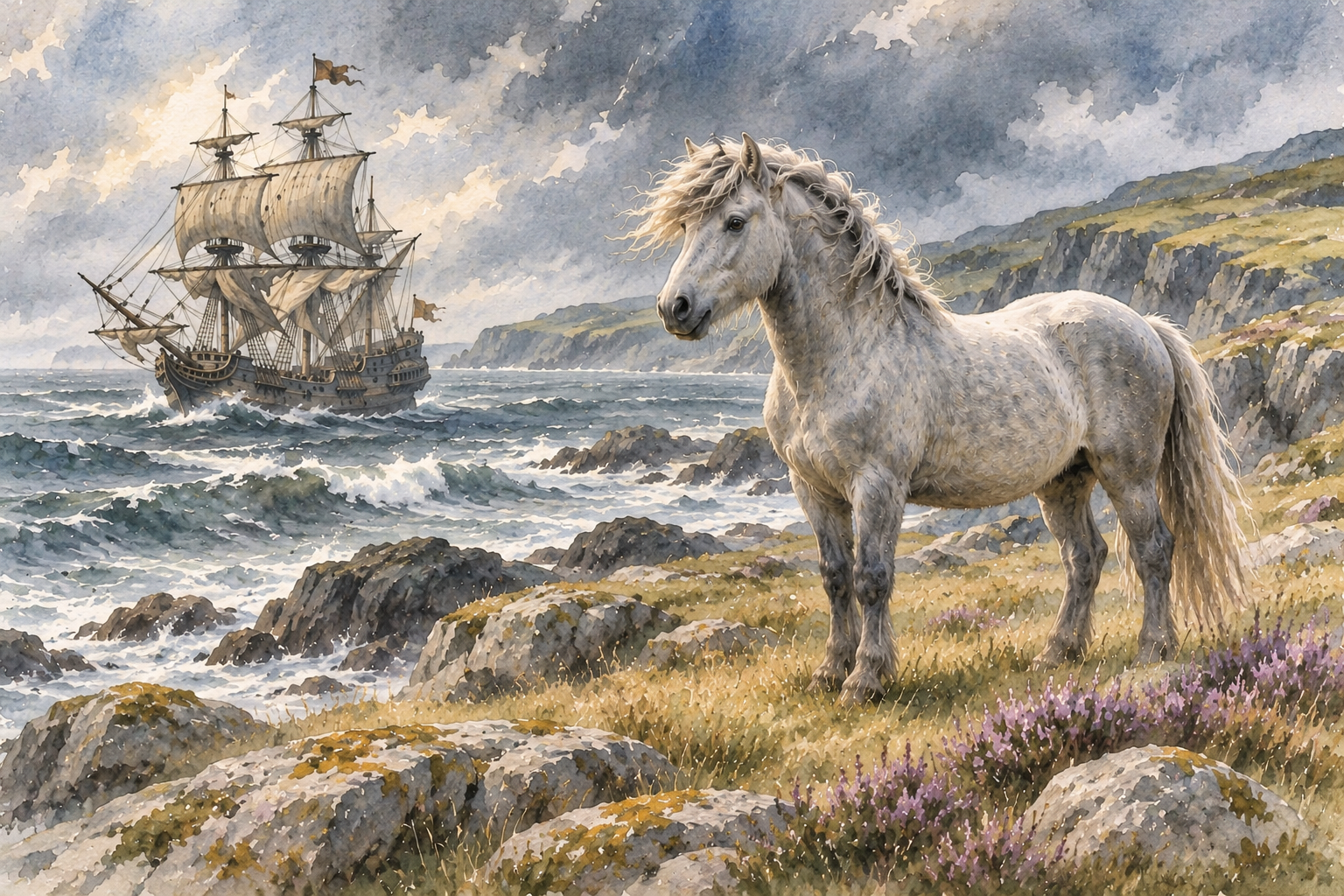
The Spanish Armada story. In 1588, the Spanish Armada was scattered by the English fleet and by storms, and a number of its ships were wrecked on the west coast of Ireland. The story goes that Spanish horses swam ashore from the wrecks and bred with the native ponies of Connemara, and that the Connemara’s hardiness, its quality, and some of its looks come from those Spanish horses.
It is a great story, and it is told with real conviction in the west of Ireland. But historians treat it as legend rather than settled fact. The Armada’s ships were not carrying cavalry: the invasion’s horses were waiting in the Low Countries to be ferried across the Channel, and the ships wrecked off Ireland carried crews and a few pack animals, not shiploads of stallions. One researcher, Robert Beck, checked the bills of lading for the Armada ships with the Spanish consul and confirmed there were no stallions aboard.
That does not mean Spanish blood never reached Irish ponies. It almost certainly did, over centuries of trade — Spanish horses were traded all over Europe in the 14th to 17th centuries, and the Vienna Y-chromosome study found a Spanish-linked fingerprint shared by Connemaras and other British and Irish native ponies. But a fingerprint shared through centuries of horse trading is a very different thing from stallions swimming ashore from a wreck in 1588. The study does not claim the shipwreck story, and neither should we.
The ancient Celtic pony story. The second story is older and vaguer: that the Connemara descends from the ponies of the ancient Celts, hardy little horses that came to Ireland with the first Celtic peoples and survived, nearly unchanged, in the mountains and bogs of the west.
There is a grain of truth at the bottom of this one, in the sense that ponies of some kind have lived in the west of Ireland for a very long time, and the Connemara’s toughness is real — it was shaped by a rocky, hilly, marshy landscape and by a life that did not forgive weakness. But “descended from the Celts” is not something any document proves. The exact origins of the Connemara are, in the words of one Irish breed history, difficult to decipher and immersed in myth and fable. We know ponies were there. We do not know, from records, whose ponies they were or where they came from before that. The Celtic story is a way of saying “this pony is ancient and it belongs to this place.” That is a feeling about the breed, and a fair one. It is not a pedigree.
Box Two: The Documented History
Here is what the records do show, in order.
Ponies lived semi-wild in the Connemara region, in the west of Ireland, for centuries. A semi-feral population is mentioned in records as early as 1399. For a long time the ponies were not a “breed” in the modern sense at all. They were a type: the local pony, shaped by the land, used for everything a small farm needed. They pulled light carriages, carried turf from the bogs, carried seaweed for fertiliser, and carried their owners to market. They had to be strong for their size, sure-footed on rock and bog, thrifty with feed, and sensible enough to live mostly outdoors. That working life is the real foundation of the breed’s temperament and hardiness. It was not romantic. It was a job.
By the late 19th and early 20th centuries, people who cared about the pony were worried it was being diluted and lost. Outside blood was coming in, the old type was fading, and nobody was keeping a systematic record of which ponies were which. That worry is what produced the breed society.
In 1923, the Connemara Pony Breeders’ Society was founded in Clifden, County Galway, by local breeders, for the purpose of conserving and developing the native pony. Inspections began in 1924. The first volume of the studbook was published in 1926. The commonly cited figures for that first studbook are 93 mares and nine stallions admitted after inspection.
What followed was decades of patient, sometimes strict, selection. Inspectors travelled the region, looked at ponies against a standard, and admitted only those that met it. In the 1940s, a calculated decision was made to widen the gene pool: three Irish Draught stallions and two Thoroughbred stallions were used, and in 1954 an Arab-sired colt followed. That is how Thoroughbred and Arabian blood entered the breed openly and deliberately — through named, recorded stallions, not through shipwrecks. The small English Thoroughbred Little Heaven and the Arabian Naseel, two of the five sire lines I wrote about in my last article, belong to this chapter of the story.
In 1964, the studbook was closed. From that point on, only ponies with both parents registered as Connemaras could enter the studbook, and no further outside blood was introduced. The Connemara became, officially and permanently, a closed breed. The Society in Clifden remains the studbook of origin — the parent society — to this day, and there are now daughter societies all over the world, including the American Connemara Pony Society here in the United States.
The breed spread well beyond Ireland after the Second World War, first to England and then much further. The largest Connemara population outside Ireland is in France. Connemaras were first imported to the United States in 1951, when a dun stallion, a black stallion, and four mares were brought to Virginia. The annual Connemara Pony Show in Clifden each August remains the breed’s great gathering, where breeders from many countries come to judge and celebrate the ponies.
That is the documented story. It is shorter than the legends, and it is better, because every part of it can be checked.
Why Keep the Boxes Separate?
There are two reasons, and both matter to me as a breeder. The first is honesty with buyers and new breeders: when someone is spending real money on a pony, or choosing a stallion for a mare they love, they deserve to know which parts of a breed’s story are documented and which are told for love. The second is that the legends, kept in their own box, lose nothing. They tell you what Connemara people value: hardiness, antiquity, belonging to a place. They are part of the breed’s culture. They just are not evidence, and they should never be used as evidence — for a breeding decision, a purchase, or a claim about what a pony will do.
If you are new to the breed, here is my suggestion. Learn the documented history first: 1923, 1926, 1964, and the working life that came before all of it. Enjoy the legends second, and enjoy them properly — as stories told by people who loved these ponies enough to give them a past as romantic as the ponies themselves. Both boxes belong on the shelf. Just do not let them get mixed up.
Sources checked: American Connemara Pony Society, “The First Inspections,” https://acps.org/the-first-inspections/3/ (CPBS founded 1923, first inspections 1924, studbook closed 1964); Irish Horse Gateway, “Connemara Pony,” https://www.irishhorsegateway.ie/dashboard/buying/irish-horse-breeds/connemara-pony/ (origins “immersed in myth and fable,” society formed December 1923, outside blood 1940–1960, studbook closed 1964); Historic UK, “The Tobermory Galleon,” https://www.historic-uk.com/HistoryUK/HistoryofEngland/Tobermory-Galleon/ (no stallions aboard the Armada ships; Robert Beck’s bills-of-lading check); ConnollyCove, “Connemara — Folklore, Landscape & Travel Guide,” https://www.connollycove.com/connemara-folklore-and-landscape/ (Armada folk origin story treated as legend); Sportsweek, “Why a Connemara pony will make the perfect hunting companion,” https://sportsweek.org/en/shooting/news/329969956/ (1923 society, 1926 studbook with 93 mares and nine stallions, 1940s outside blood, studbook closed 1964). Thesis details are from Jetzinger (2026), University of Veterinary Medicine Vienna, as summarised in the earlier sire-line article draft.
For a closer look at one legend in particular — the Spanish Armada — and what the new DNA evidence actually shows, read Spanish Blood in the Connemara? What the DNA Actually Says.





For more of our latest photos and inspiration, follow along on instagram at @instapony_.
© Redbud Ranch 2020 | Connemara Sport Horses and Ponies | photos by Lisa Martin |
terms & Condtions |
privacy Policy
Intentionally Bred with People in Mind
Browns Valley, CA
+ Show / Hide Comments
Share to: