


Affiliate disclosure: This post contains affiliate links. If you buy through my Mad Barn shop link, I may earn a small commission at no extra cost to you. Use code 5%-OFF-FROM-LISA-M at checkout for 5% off. I only link products I actually use.
I have had horses for 49 years, since I was 11, and I have bred Connemara crosses since 2002. This fall was the first time I ever fed teff hay. I wrote about why I tried it in my first teff post — the lab analysis, the five trial horses, and why Blue and Ruby were not in the trial. This is the follow-up: what I have actually seen so far, what I am still watching, and what I still do not know.
If you have not read the first post, the short version is this. My Fallon second-cutting teff, analysed September 8, 2026, came back at 5.26% ESC plus starch and 9.10% NSC, with 11.81% crude protein. That is a high-fiber, moderate-protein, low-sugar hay. Five horses are in the trial: Ty, Z, Jack, Barbie, and Endeavor. R Blue Moon stays on alfalfa crossed with timothy, and Ruby, my 2-year-old filly, has her own ration. A low-energy hay is the right tool for an easy keeper and the wrong tool for a stallion who needs condition or a growing filly who needs to grow.
The trial started the evening of Oct 29, 2026. Today, Nov 10, is about twelve days in. That is long enough to say how they are eating it and what the hay looks like up close. It is not long enough to call it a result on weight or condition. The re-tape is still Nov 28, and I will say more when I have weights to go with what I am seeing.
What the Hay Looks Like Up Close


These are the bales I am feeding, photographed Nov 10, 2026. Up close it is exactly what the first post described: fine-stemmed, dry, pale grey-green, and very soft to handle. Most of it is fine, flat stems, with some longer, thicker pale stalks mixed through. It is not straw. Straw is what is left after the grain is taken off. This is forage-cut hay, and you can feel the difference in your hand.
The Routine Now
As of Nov 6, the routine is: Ty, Z, Barbie, and Endeavor each get 1 flake of teff at night, about 5 lb each, and Jack also gets about 5 lb of teff a day. That is about 25 lb of teff a day for the five trial horses, about 175 lb a week.
Endeavor and Barbie get alfalfa with their teff. Z and Ty get timothy with their teff. Blue and Ruby get no teff — Blue and Ruby are on alfalfa and timothy, 5 lb of each a day.
On Nov 6 I was finishing the second of the 8 teff bales I bought Oct 29, with about 6 bales left.
The Change I Noticed First
The change I noticed first was not weight. It was settledness.
A half flake of alfalfa is rich and it is gone fast. Then the horse stands with an empty gut, waiting for the next feed. A full flake of teff takes longer to chew, keeps the belly full longer, and delivers its energy slowly. The trial horses seem calmer getting a full flake of hay rather than half a flake of alfalfa.
I am saying “seem” on purpose. This is early, and I am not calling it a result yet. But it is exactly what I would expect from the difference in chew time and gut fill, and it matches what I see at the fence: horses with a full flake in front of them, chewing steadily, instead of horses finished and waiting.
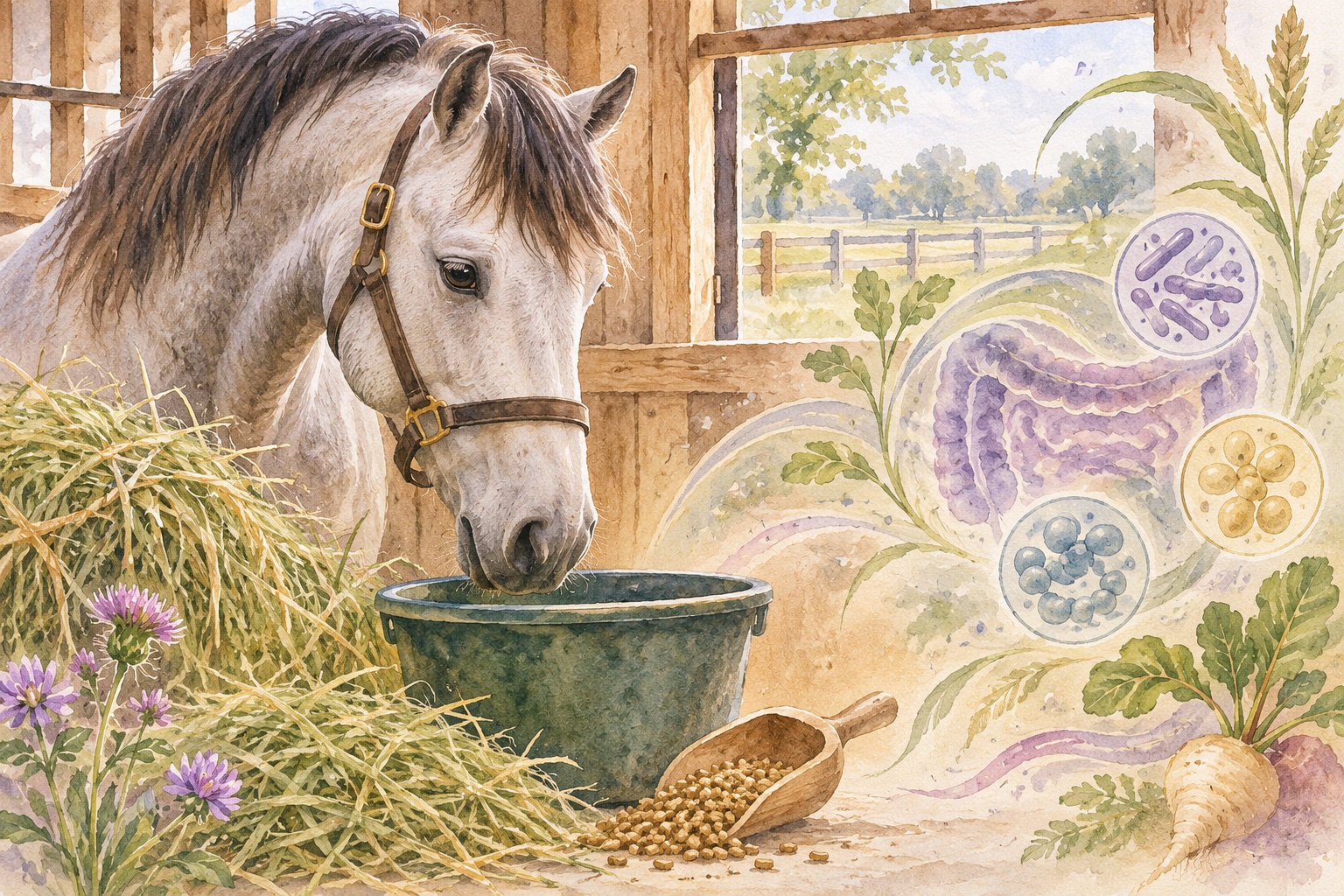
All that chewing matters for another reason. Chewing makes saliva, and saliva helps buffer stomach acid. Fiber is also what the hindgut runs on. The microbes in the hindgut ferment fiber and turn it into slow, steady energy, which keeps the gut moving and keeps things more even than a ration that spikes and drops.
Jack, who is 22, was the most interested in the teff the first night I fed it. He ate it with no issue. At his age I watch his chewing and his condition closely, and so far he is eating it well. That is an observation, not a verdict. His topline check comes December 1, with a fuller verdict January 1, and I will say more then.
Twelve days in, no one has had a bad reaction to it. The older horses — Jack, Barbie, and Ty — seem to love it. The younger horses are still acquiring a taste for it, but they are eating it. They have eaten everything offered — no hay left behind.
What Has Not Changed
The balancer has not changed, and that is deliberate.
Teff does not balance a ration by itself. No hay does. On my lot, magnesium is low at 0.11%, and the lab sheet did not report copper, zinc, iron, or manganese at all, so I do not pretend I know those numbers for this lot. The balancer stays constant while the hay changes. That is the whole point of a balancer: it fills the gaps the hay leaves, whichever hay I am feeding this month.
Fresh grass is done for the season here, so hay has to carry the whole forage load now, and fresh-grass vitamin E is gone with it. My horses get a balancer, salt, and vitamin E because hay alone does not cover everything. If you switch to a high-fiber hay and drop the balancer because the hay looks simple, you have missed the point.
I also still keep a small amount of alfalfa on hand. It is for Ruby’s ration and for top-ups, not as a base hay. Jack gets a small morning alfalfa top-up, and since that started his topline has looked better. That is an early signal that points toward a protein shortfall rather than something else, but the December and January checks still stand. I am not drawing a conclusion from a few weeks.
What I Am Watching
Three things, and I am watching them in this order: how they eat, manure, and condition.
How they eat comes first because Jack is 22 and teff is fine-stemmed and dry. This lot is also high in ash at 11.12%, which usually means some dirt in the bale, so I shake it out and I do not feed off sandy ground. If a horse starts quidding, dropping feed, or leaving hay, I want to know that day, not at the next weigh-in.
Manure tells me whether the hindgut is happy with the change. Condition tells me whether the energy is right. I will re-tape Barbie, Endeavor, and Ruby on November 28 and decide then whether the bigger load and the higher share of teff still make sense. If a horse is not holding condition, I will add alfalfa rather than just feeding more teff. More of a low-energy hay is not the same as the right amount of energy.
For a mare in late pregnancy or lactation, or a growing foal, I would reformulate the whole diet. The trial ration is not a gestation ration. That is a different job, with higher energy, protein, lysine, calcium, and trace minerals, and alfalfa has a place in it.
The Cost Part, Honestly
Teff was considerably cheaper per pound than the Timothy Balance Cubes I had been buying, about 29 to 33 cents a pound against about 74 cents a pound for the cubes. That helped. It was not the reason I tried it, but when you are building a barn, it is not nothing either. I may still keep some cubes to soak for extra water. I am just not buying them as bulk forage anymore.
I buy almost all my hay at Tommi’s Hay Barn in Loma Rica.
Is Teff Hay Good for Metabolic Horses?
That is the question I get, and the honest answer is: it depends on the lot, the horse, and the rest of the ration.
A low ESC plus starch number helps. Mine is 5.26%, which is low enough that no soaking was needed for sugar on this lot. But a different lot, a different cutting, or a different field can test differently, and a hay analysis on my lot tells you nothing about yours. Get your own lot analysed. Read the ESC plus starch, not just the headline NSC. Transition slowly. Keep the balancer constant. Tape and weigh, and let the horse tell you.
Low sugar does not guarantee anything on its own. For an easy keeper, or a horse that runs a bit metabolic, a low-sugar, high-fiber forage is a much easier place to start than a rich hay fed in a small amount. It is a starting place, not a treatment. If your horse has a metabolic diagnosis, laminitis history, or is on medication, talk to your vet before you change the forage. I am sharing what I fed and what I saw, not prescribing for your horse.
What I Think So Far
I think teff is a good tool for the right horses: easy keepers that need a full belly, a long chew, and steady, low-sugar forage. I do not think it is a miracle hay, and I do not think it suits every horse in the barn. The trial is still running, the re-tape is still to come, and I will say more when I have weights to go with what I am seeing.
For now, the horses are eating it, they look settled with a full flake in front of them, and I finally have a hay I can feed in a proper amount without feeding too much horse with it.
— Lisa Martin, Ballymoon Farm, Browns Valley, California

Previous Post
Next Post






For more of our latest photos and inspiration, follow along on instagram at @instapony_.
© Redbud Ranch 2020 | Connemara Sport Horses and Ponies | photos by Lisa Martin |
terms & Condtions |
privacy Policy
Intentionally Bred with People in Mind
Browns Valley, CA
+ Show / Hide Comments
Share to: